
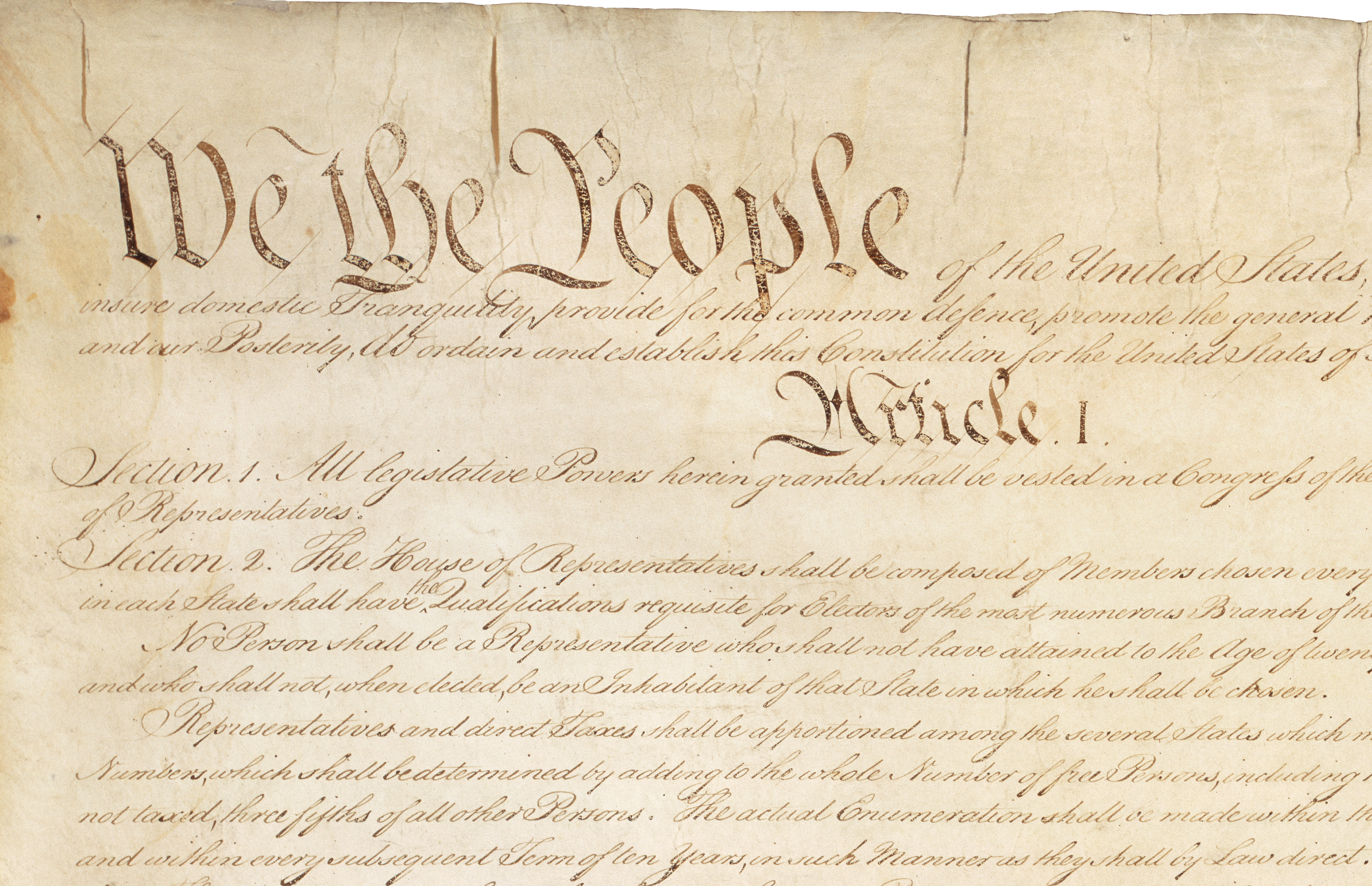
In previous posts we have discussed Lincoln’s “government for the people” (here), where the people are the beneficiaries of the government’s actions, and “government by the people” (here and here), where the people are the agents of the government’s actions.
We come now to “government of the people” — first in Lincoln’s formulation and last in our interpretive exercise. Here we discuss the people as patients of the government’s actions. I have saved it for last because I find it the most polyvalent and perhaps most evocative prepositional phrase of the three. Its most obvious meaning would be of in the sense of “government over the people.” Wherever we have an organized state, something more than anarchy, we have the need for governance, and that governance must be of the populace. This was explicitly what Theodore Parker said in one of his earlier formulations, “government over all the people, for all the people, by all the people.” But Lincoln does not use “over,” he uses “of.” And he was far too careful a wordsmith for us not to take his choice seriously.
Merriam-Webster lists seven primary meanings for the preposition “of,” with sub-meanings adding up to twenty-two. So, the term is pliable and potent. I think at least three meanings are helpful here.1
- As just noted, “of” could be taken as a synonym for “over.” This surely is one of the meanings that Lincoln intended. The formula for democracy would not be complete without identifying the subjects of democratic governance. And there is a good deal to unpack in this idea alone, which we will discuss below. But, there is more . . . .
- Of could mean the government belongs to the people, as in “a possession of mine.” It is certainly plausible that Lincoln wanted to say that government belongs to us, is controlled by us, and is for our benefit. There is a thin line between “belongs to” and and “by,” but “belongs to” evokes a more overarching sense of responsibility.
- Of could mean that the government is composed of the people, it is drawn from the people. In contrast to many corporations, which permit non-shareholders to be elected to the board of directors, members of Congress and the President must be US citizens; they are “we” and we are they.2
Let’s reflect further on these three meanings, “of” as a synonym of “over,” as a matter of possession, and as a synonym for “drawn from.” In all respects historical and contemporary tensions are implicated — and I have to believe that Lincoln was aware of them in his own time. All three involve an existential question: who are the people?
government over the people
Not all who are patients of the government are agents in the government. Non-citizens are subject to law but have no say in its making. Minors are subject to the law but do not have all the rights that those who have attained majority do, neither do they have the vote — they have no part in government by the people (at least in the sense of enfranchisement). Until the late 1800s in some states, and until 1920 nationwide, women had no agency but were certainly subject to the law, indeed, to laws more restrictive than those applying to men. Even more egregiously, and dishonestly, slaves were counted as three-fifths of a person for purposes of electoral representation, but of course those same slaves had essentially no rights — i.e., were largely not persons under the law — and had almost no protection by the government. As property, their masters’ agency over them far outweighed the government’s.
So, when Theodore Parker made a point of saying “government over all the people,” he was in effect acknowledging that at the time, it was a fiction. The point is that legitimate government — irrespective of who has agency in the government — cannot exert its control differentially over its subjects without a basis in legitimate differentiations among those subjects. There are legitimate reasons for the government to treat children differently from adults. There are not legitimate reasons for the government to treat women differently from men or blacks differently from whites.
Unless, of course, pursuant to its role as government for (all) the people, it undertakes differential treatment in order to right wrongs or correct illegitimate discrepancies that exist among citizens. Affirmative action and Title IX are examples of this.
Government of the people that is not responsive to the requirement of government for the people is government hollowed out.
government belonging to the people
The government — including all of its assets, such as (what was) the East Wing of the White House, the Kennedy Center, the Reflecting Pool, East Potomac Park, even the vista from the Lincoln Memorial to Arlington National Cemetery — belongs to us. It is imperative today that we understand this, because it is clear that Trump believes the government belongs to him. It is his private money-making machine and his exclusive domain. And while he is the worst example of corruption in our history, wherever there is corruption in government, there is an attack on government of the people. (This is as true of Type 2 corruption as it is of Type 1 corruption, as I discussed in this post.)
And it is more than that. We invest in the government with our taxes and with our service, and we rightfully expect that our government officials will treat those investments as the public trust that they are. We rightfully expect that we will reap a return on that investment — a return in equality, in unalienable rights, in life, liberty, and our pursuit of happiness. One of the myths of so-called small government is that it frees the people, frees their resources, from constraints. People complain about government taxes, failing to understand how, in so many ways, if we are not taxed by our government, we are taxed in other ways. We pay local and state taxes that are, for instance, invested in road maintenance. If those taxes are insufficient, or if those in power do not steward them properly, we pay a different kind of tax in car repairs and car depreciation from wear and tear.
Government of the people means that we the people have formed our own collective mediating force in the world: mediating amongst us, and mediating between us and forces — human and natural — that we have to contend with. This is the basic idea underlying the social contract theory articulated by philosophers such as Hobbes, Locke and Rousseau, although each gives it a different motivation. It is related to Plato’s argument in The Republic that the state arises from the fact that in isolation, no one is self-sufficient; we need a cooperative division of labor with others to meet all of our needs and to flourish. We can see this power of our collective action in many ways, such as our national defense, and we can hope that we eventually realize it more fully in other ways, e.g., to do right by all of us through national single-payer healthcare.
Government of the people also means that we the people have an entity that embodies us, our affinity for each other. Aristotle nicely balances this aspect of government with the one articulated above when he sets forth two essential virtues for the state: justice and friendship. Neither virtue has much play in our current government. And demagogues like J.D. Vance, in their harping on the idea of natural ties among people as the basis of being American, seek to elevate a false notion of friendship above justice; that is a core of fascism. One of the dangers that we face at the moment, our extreme polarization, is the disintegration of our national friendship, our longstanding mutual commitment to certain ideals, but also to an ethos of respectful discourse and debate. This is not a simple issue, and I hope to post more about it in the future.
government drawn from the people
We are, in principle, an elective, representative democracy. We cannot possibly go into all the ways that we fall short of that ideal, so let’s just take a large view to start: we have a more-or-less representative system, in which citizens are elected to office. The House of Representatives, for instance, is designed to provide local accountability; our representatives are not just accountable to us, but at least in theory they are one of us: they live where we live, they experience life as we experience it, and so on. (One of the pernicious aspects of gerrymandering is that it distorts this locality.)
Of course, we the people are not just local. We belong to many communities, local, regional, state, national. In my case, I am a citizen of Chelsea, Michigan; of Washtenaw County, Michigan; of the state of Michigan; and of the United States. And I should be able to expect my representatives to reflect all of those communities, in degrees appropriate to their offices, and understanding how those communities interact.
In brief, government of the people entails that government should have some understanding of the people, of how they live, of what matters to them, of what makes a difference in their lives. We elect our representatives not just on their platforms but on our sense of their understanding of us. And we expect that we can confront them in town halls with our questions and concerns and that they will respond with some understanding of our context. (I dread the day when AI can really simulate that, if it is not already here.)
“Of the people” in this sense is at risk from oligarchy, from the obscene influence of money, which places the interests of the wealthy between the people and their representatives. This is one of the biggest issues we face, and it is imperative that we address it.
“Of the people” in this sense has also been used perniciously. Trump got his political start through birtherism — i.e., by claiming that Barack Obama was not one of us. MAGA is driven by irrational fears that people who are not of us are getting involved in our politics (immigrants), in our military (transgender citizens), in our society (all who don’t fit their world view). We are now facing a concerted effort by the Trump Administration to cleanse our nation of the unwanted. Dr. Martin Luther King, Jr., said that the United States had issued a “promissory note” — a note that had been returned marked “insufficient funds.” By that measure, we are now deeper in the red than we have been for a long, long time.
The promise of our democracy is that we are all equal, and the basic requirement is that we accept and promote that equality. The fact is, we are a multi-racial, multi-ethnic democracy that has evolved, against many constraints but drawn on by its stated ideals, toward ever greater inclusion in the understanding of who we the people are. What should the extent of King’s “promissory note” be? As far as humanity would be an answer.
Our effort to expand our understanding of who we are, of who is of us, is under assault. This is not the first time that has been true. For all of our history there have been assumptions unquestioned by the majority about who belonged and who didn’t. Maybe they were not always as clear as slaves constituting three-fifths-of-a-person under the Constitution, but they were certainly ensconced in segregation and redlining and Native American reservations and gender restrictions and a host of discriminatory policies. In other words, as we are increasingly coming to understand, our country is in part defined by white supremacy and never as democratic as we thought.
And so the present hate-and-resentment-filled backlash is predictable. But I want to think that the degree of it is not representative of who we are. Most of us have a deeper understanding of what makes us, us. Oligarchy combined with a super-empowered minority is driving the backlash. It is essential that we have a massive response that will put us back on the path of democratic justice and friendship.
1A fourth and obvious translation would be along the lines of “The decision of the judge was . . . .” But this essentially collapses the phrase into “government by the people,” and that redundancy seems unhelpful.
2Interestingly, there is no such Constitutional requirement for Supreme Court justices. Perhaps the next president, if a Democrat, could appoint Carney to the Court.)

