We are a small group of friends and neighbors who reject the turn to authoritarianism, racism, and lawlessness shown by the current Federal government. This site will serve as a hub for sharing stories and discussions about the realities facing our country and our many communities.
We support a just and equal multicultural democracy, governed by law and constitution, and we want to work together to return our country to these values. In Rousseau’s words, we support a “free community of equals”.
We have many thoughts and fears about the policies and actions of our government today. We do not have a shared credo, but we are united in our love of freedom, equality, constitution, mutual respect, and civil community.
In particular, many of us notice many of the same things:
We condemn the assault on immigrants and the cruel and lawless enforcement regime the Federal government has enacted.
We are horrified at the assault on Medicaid and the likely effects these policy changes will have on millions of people in our country.
We reject the administration’s attack on scientific and medical research, universities, and academic freedom across the country.
We fear for the future of our country when we consider the ongoing assault on medical research and sound public health planning.
We condemn the current administration for its lawlessness and its contempt for both Constitution and the Federal judiciary.
We abhor the administration’s efforts to censor and dictate the museums, libraries, parks, and collections that document our country’s history and share its art, music, and literature.
We are ashamed of our government’s desertion of Ukraine and the president’s embrace of a bloody-handed dictator, Vladimir Putin.
We reject utterly the administration’s lawless use of unjustified military force to compel nations in the western hemisphere to comply with the new imperialism envisioned by the president, including the illegal invasion of Venezuela and the threats of similar military action against Columbia, Mexico, Cuba, and Greenland.
We are horrified at the embrace of white supremacy and racial resentment that is encouraged by the current government.
We reject the government’s war on Diversity, Equity, and Inclusion, with full awareness of how far our society must go in order to achieve real justice.
Readers are encouraged to find their own ways of supporting peaceful protest and advocacy in support of our shared democratic values and institutions. There is power in collective protest and shared support for our constitutional system.
Comments and guest posts are invited.
Gary Krenz and Dan Little will serve as co-editors of the site.
If you have an enemy in the Congress send armed men to forcibly enter her home, and try to revoke her citizenship. And only 22 days till the election … What else is coming?
In the last post in this series, we discussed prudential and existential reasons that democracy is, in some form, the appropriate form of government for free, equal, dignified human beings. Now, let’s dig a little deeper.
Lincoln, in the Gettysburg Address, posed a concern: if America failed as a nation, government “of the people, by the people, for the people” would “perish from the earth.” What some have called the “American Experiment” is just that — it begins from an hypothesis, that “all the people” are actually able to govern themselves — and we might add here, in a way not previously seen in history. The Civil War, in Lincoln’s view, was a genuine threat to that ideal. And it was so because the war was wrapped around the question that had plagued the then-eighty-year-old nation since its conception: how could a nation “dedicated to the proposition that all men are created equal” countenance slavery in any form?
The sad fact is that government by the people does not guarantee that it will be government forall of the people. It is, in short, no guarantee of democracy, if we take all three parts of Lincoln’s formula — of, by, for — to be necessary and sufficient for democracy. Majorities can be tyrannical — and American history has shown how the majority can be tyrannical and even totalitarian: slavery, Jim Crow, redlining, removal, the list goes on. Government by the people means that all government does is done in our names. Moreover, the majority can succumb to demagoguery and become, in essence, a mob. We know this all too well today, although, to be sure, Trump’s support has come from super-empowered minorities rather than genuine majorities.
The Founders were so concerned about mob rule that they implemented many checks on democracy, checks that not surprisingly protected their own class interests. They wanted to mediate and moderate the people’s voices. And they were not entirely unjustified in their concerns. An electorate ill-informed and ill-educated is an electorate ill-prepared to act for the people with its engagement or its votes, as the MAGA movement clearly demonstrates.
Over time, our government has undergone a long process of democratization:
the 13th, 14th, and 15th Amendments to the Constitution eliminated slavery and democratized citizenship.
the 17th Amendment gave the people a direct voice in the election of Senators
the 19th Amendment gave women the right to vote, finally extending the franchise to half of the population that had been denied it.
the 23rd Amendment gave the District of Columbia representation.
the 24th Amendment eliminated poll taxes, which had greatly restricted the poor from voting.
the 26th Amendment extended the right to vote to 18-year-olds — recognizing that if you could serve in the military at 18, you ought to have a say in the government’s decisions about engaging in war.
All of these amendments have either expanded who is included in “government by the people” or how much say we the people have in our own governance. I will not go into all of the other factors and agents, such as the Great Depression and FDR’s response, that extended this democratization.
So here we are, with this history of democratic expansion, now facing a concerted oligarch-driven effort to reverse that democratization. We should be moving toward even more expansive democracy: eliminating the power differentials created by the Senate and the Electoral College, by private funding of political campaigns, and more.
So the question is: what does it take for government by the people to effect government for the people? How do we the people effectively pursue our founding ideals — that all are created equal and that we all therefore have rights to life, liberty and the pursuit of happiness?
There are Constitutional and structural reforms that are needed, such as those hinted at above. We also need somehow to deal with a communications environment corrupted by polarization, misinformation, and disinformation. Thinkers from Thomas Jefferson to John Dewey to Amy Gutmann have philosophized about the need for an educated electorate for an effective democracy. I think that this issue is salient — and I don’t really know even how to work toward an answer.
Beyond the information problem, though, there is something more: we must recover a culture of democracy. We have learned, all too late, that policies, rules and regulations are not enough in themselves. Democracy requires a culture of good will. A culture that embodies our equality and our unalienable rights, as well as the responsibilities for each of us that those entail. It would be a culture imbued with virtues such as respect, openness, sympathy, concern, kindness, honesty, communicativeness, acceptance, engagement. In short, all of the virtues that are opposite to Trump’s culture of cruelty, dishonesty, corruption and closure.
Can we really embrace the ideals of the Declaration? Our 250-year history can give us hope — we have overcome many sins, including slavery — but our recent history gives us pause. That said, polling indicates that a majority of Americans really do seek to embody many of these democratic values. And the more that people see the impact of Trump’s anti-democratic policies on real people, the more they react with outrage.
The culture of democracy requires not just that we exercise our democratic authorship, but that we exercise it on behalf of democratic ideals. Government by the people is intimately linked to genuine government for the people — and, as we will discuss in the next post — government of the people.
We need to think very clearly about the policies and actions our government is carrying out with respect to “illegal immigration”. The Trump administration has waged a war of hate-based language and accusation against non-citizens in the United States, and has set the goal of achieving one million arrests and deportations annually. It has characterized the undocumented peoples currently living and working in the United States in the most dehumanizing and racist terms, specifically aiming to whip up fear, distrust, and hate against non-US-born people, mostly black and brown. Think of Trump’s language about the Somali communities of the midwest (“Garbage!”), Trump and Vance’s lies about Haitian refugees in Ohio (“they’re eating the pets!”), and blanket racism about people from Mexico and Central America (“criminals and rapists”).
The language and lies expressed here are entirely reminiscent of the anti-Semitism of the Nazi rise to power. They serve the purpose of dehumanizing this whole population of people, turning them into something “subhuman” and dangerous. It is racism, it is white supremacy, and it is fundamentally shameful and wrong. It is the language used by Nazi leaders like Eichmann in their efforts to rid Europe of non-Aryan peoples.
The language and lies are accompanied by practices, actions, and policies that are both extra-legal and fundamentally brutal and evil. The use of deadly force by ICE agents is too wide to be the work of the occasional “bad apple”; it is the systemic result of an armed government secret police force that does not recognize normal procedural protections for human life and welfare. Only in fascist states, Stalin’s regime (and often enough, the Jim Crow South) were armed security services so unhampered by law and training from the exercise of brutality and violent death against “suspects”.
The goal of removing one million peaceful men, women, and children per year because of their national origin is nothing short of ethnic cleansing — the use of violent means to force masses of a population to leave a region or country. It was familiar in the Nazi era, it was common in the period of the breakup of Yugoslavia, and it is happening in the United States. It is fundamentally shameful for every one of us — whether we supported Donald Trump in 2024 or we did not. The actions now being taken by the US against millions of human beings is a mark of inhumanity that all of us are responsible for.
And what of the children? Since we all met five-year-old Liam Conejo Ramos some months ago, we’ve known that the children of non-US-born parents are at grave risk. CNN posted a report today about unaccompanied children being forced to appear in immigration courts to plead against deportation (link).
In a Texas courtroom Monday, 25 migrant children lined the pews — a 6-year-old pretended to fly an airplane, a 3-year-old played with the mic, and a teen girl tried to make eye contact with a friend. The judge reminded everyone of what was at stake.
“I see you’re smiling and think these proceedings are funny, but I need you to pay attention,” the judge told the teen girl. “They could determine whether you remain in the country or are removed.”
Migrant children as young as 2 are showing up at immigration courts nationwide, many without attorneys, to make their case to stay in the US and avoid deportation.
It is heartbreaking to think of these children, alone, facing deportation to a country they often do not even remember, and to think of the inexpressible cruelty of a government that inflicts this pain and lifetime loss on children. Like the “family separation policy” of the first Trump administration (link), its purpose seems literally to impose pain on these children and their parents, as a deterrence to other people thinking of passing into the United States.
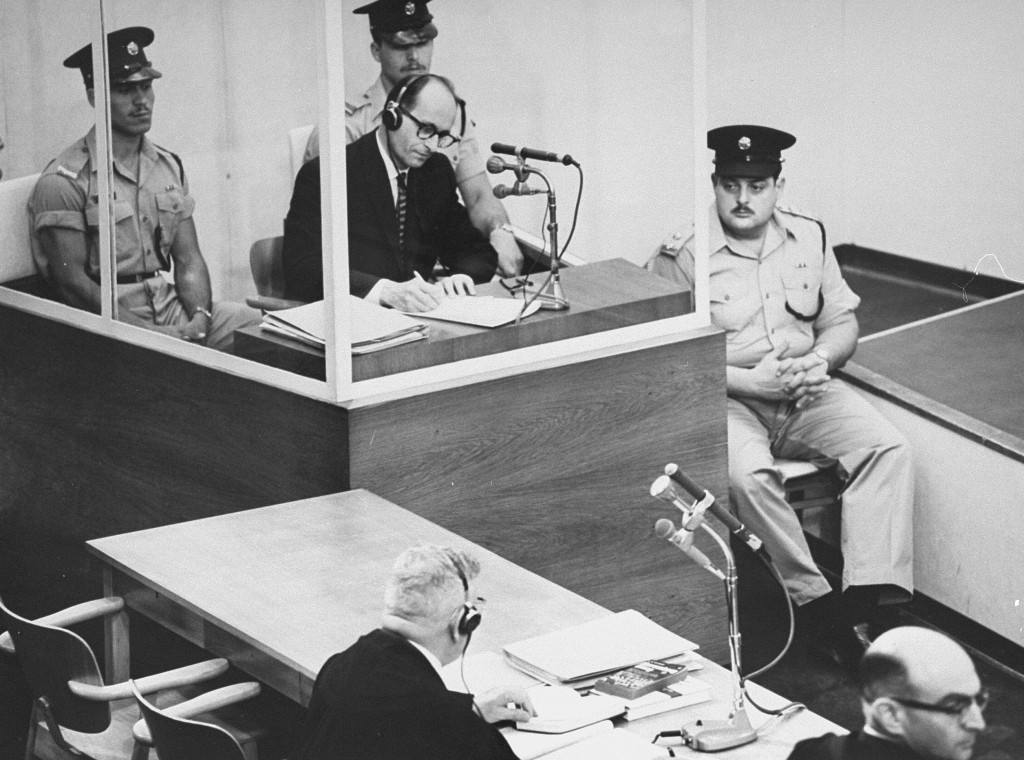
In 1940 Adolph Eichmann was tasked to develop a plan for deporting Europe’s Jews to Madagascar. Here is a description of Eichmann’s plan from Wikipedia:
Adolf Eichmann, the head of the RSHA Sub-Department IV-B4, which dealt with Jewish affairs and evacuation, soon became involved. On 15 August, he released a memorandum titled Reichssicherheitshauptamt: Madagaskar Projekt (Reich Security Main Office: Madagascar Project), calling for the resettlement of a million Jews per year for four years and abandoning the idea of retaining any Jews in Europe. The RSHA, he emphasised, would control all aspects of the program.[27] While Rademacher called for the colony to be under German control but self-governing under Jewish administration, Eichmann made it plain that he intended for the SS to control and oversee every aspect of life on the island, which they would govern as a police state.
Notice the brutality, scope, and SS control that are specified by Eichmann. Each of these is a feature of today’s campaign of arrest, detention, and deportation.
Here is an excerpt from Eichmann’s trial in Jerusalem concerning the Madagascar plan (link).
Stephen Miller, as longstanding designer and advocate for the administration’s current plan for deporting one million men, women, and children per year, you will be remembered as sitting among the most appalling criminals against the innocent of our century.
I’d like to continue our meditation on Lincoln’s “formula for democracy” in the Gettysburg Address, “government of the people, by the people, for the people.” The prior posts in this series are here and here. We’re looking at the formula from end to beginning and started with government “for the people,” so today, let’s look at government “by the people.”
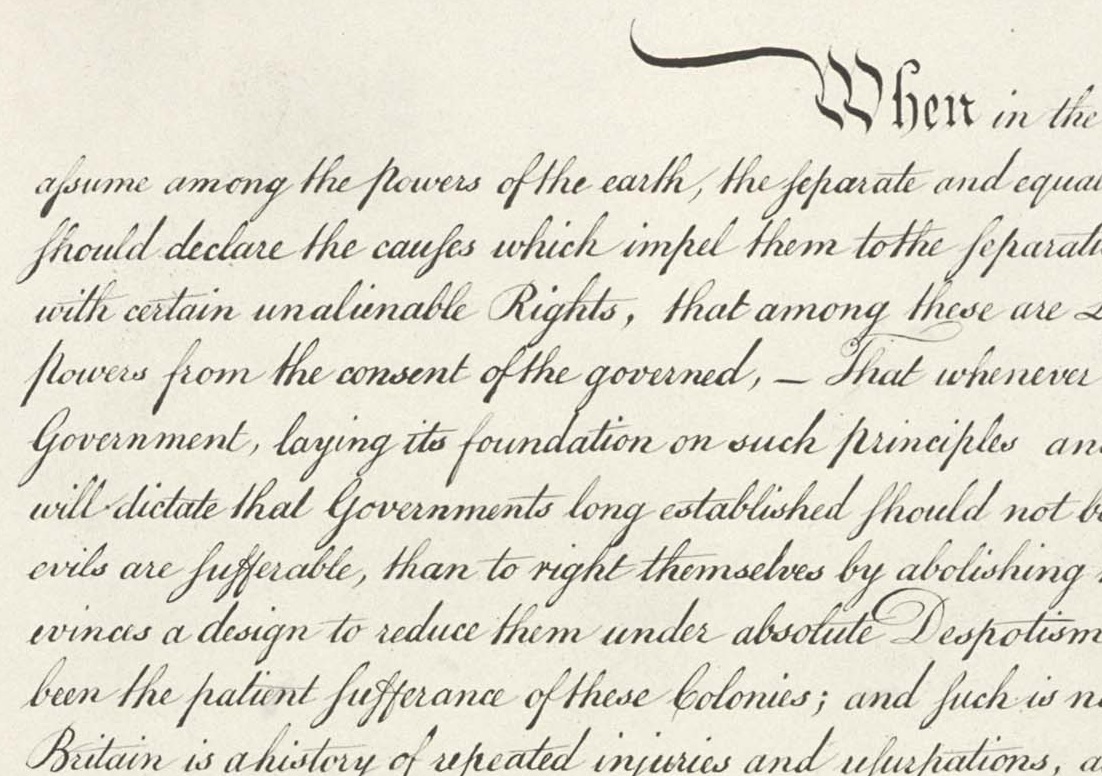
Government by the people introduces a function specific to democracy: the participation by the people in their own governance. It articulates the people as author and operator of the government; as the Declaration says, the government derives its “just powers from the consent of the governed.” This might be accomplished directly, as in legendary New England Town Hall meetings, or by representation, as are virtually all democracies, of course.
Why does government by the people matter? If a just and righteous monarch can deliver on goverment for the people, why should we not be satisfied? Why should we want to author our own governance?
Let’s consider two reasons, a prudential one and an existential one (or, if we want to be more philosophically technical, a consequentialist reason and a deontological reason).
The prudential reason is that only government by the people can sufficiently guard against the potential — indeed, over time and in aggregate inevitable — abuses of power by the ruler. “If men were angels,” Jame Madison said, “they would have no need of government.” The corollary is, since men are not angels, we cannot wholly trust one or a few of them to shepherd the life, liberty and pursuit of happiness of the many. Bach’s beautiful aria, quoted in the previous post, conveys the sense of protection, the sense of security, that good government provides its people. The Declaration focuses on the need for government to secure “safety and happiness.” But in the absence of democratic government by the people, such protection is more subject to manipulation. The fewer the levers of power, the easier it is for an individual ruler, or a cabal of oligarchs, say, to ignore or control the people. In an authoritarian regime, the people have little recourse should the autocrat forgo protection of the people in favor of his own gain.
The existential reason for government by the people is that it is the proper form for the existence of beings that have human dignity, freedom and equality — the self-evident truths of the Declaration. Writing in Germany at about the time our Revolutionary War was ending, Immanuel Kant spoke of “man’s release from his self-incurred tutelage” (or immaturity) that the Age of Enlightenment was witnessing. By tutelage he meant the “inability to make use of one’s understanding without direction from another” — a childlike state inappropriate for an adult. And Kant located this self-incurred tutelage not in a failure of reason but in a failure of courage, an abdication of one’s fundamental human liberty.
When the authors of the Declaration wrote of self-evident truths, they were writing very much in this vein. The truth of equality and unalienable rights can be known by anyone, if they have the courage to see it and act on it.
Government for the people that is not also by the people is by its nature paternalistic and condescending. When Bach’s aria appeals to “what makes countries happy” as a criterion of good governance, we might ask, who is to be the judge of that? Who determines what is the “happiness” of the country, its flourishing, its well-being? The prophets of the Old Testament, the Aztec priests, the brahmans of India, would have answers. Such answers are not and cannot be our answers. For one thing, we live in a state of diversity and plurality not easily envisioned in those societies. For another thing, human dignity requires that we the people be the judges. We can take advice from the prophets and brahmans but not direction.
In other words, we must consent to our governance, and if we give up our consent, we have chosen tutelage. And of course, consent is not only a matter of voting. It is a matter of the entire apparatus by which government is transparent to and accountable to the people. Government that is not transparent is not government by consent, and if we accept the premise of the Declaration, it has no “just powers.”
Today, our consent to governance is under assault from many sides, which is another way of saying our democracy is under assault. We the people are being denied consent on a daily basis:
Executive order after executive order, of unprecedented scope, with little or no explanation, has moved us into a government by dictate.
ICE acts as a lawless arm of the Donald Trump regime, murdering and brutalizing American citizens, shooting “suspects” virtually at will, with no transparency and almost no repercussions.
Trump tries again to ban media from the White House because he doesn’t like the coverage, he sues an Iowa newspaper for the same reasons, he seeks total control of information and the creation of a propaganda machine that even his informal machine, Fox News, can’t stomach. Fortunately, the courts seem to be holding firm.
Mike Johnson shuts down the House before the midterms to avoid dealing publicly with a host of difficult issues. Indeed, we could not ask for a clearer example of “self-incurred tutelage” than the Republican Congress.
SCOTUS, under cover of a dramatic expansion of the shadow docket, enhances Trump’s unchecked powers without explanation.
Gerrymandering has reduced competitive districts — one measure of transparency and meaningful consent — to a handful.
MAGA works overtime on voter suppression, seeking to deny consent to a significant portion of the electorate.
Fortunately, we still do have the power of the vote, the ultimate backstop of consent, to work with — so please do everything you can to turn out the vote in the midterms. Get involved with the upcoming No Kings Day of Action. Join a Protect the Election effort. We have obstacles to overcome. But we can still exercise our consent; we can still author our government.
There is much more to be said about government by the people, so I hope to do a second post along that line, before turning to government of the people.
For good reason, governmental corruption is much in the news now. The level of graft in the Trump Administration has reached astounding levels (I posted a brief overview a couple of months ago, and of course it has only grown since).
A widely covered Gallup poll shows Americans’ belief that government corruption is widespread has reached an all-time high: 89% average, with Democrats at 91%, Independents at 90%, and Republicans at 83%. To be sure, the data are complicated and reflect our political polarization. Gallup notes that Republicans have over time been more suspicious of government corruption than have Democrats and Independents, and during the Biden Administration 87% of Republicans thought corruption was widespread. Still, the Republican number has been edging up over the course of the current Trump term. So I think we can call this an across-the-spectrum phenomenon.
If corruption — particularly in the midst of an affordability crisis that Trump seems congenitally incapable of grasping — is what finally incenses enough people to throw the bastards out, let’s take the win. One of the most remarkable aspects of Trump’s graft is that it happens in full view with barely any attempt at justification. Graft is no longer something that the Administration gets away with, it is the primary business of the administration. The Mob has taken over. And maybe finally we the people are reacting to it.
All that said, we need to put the numbers, and the concept of government corruption, in context.
The fact is, American government today is corrupt, and has been. Not in the way of Trump’s graft — let’s call that Type 1 corruption. And we will always have Type 1 corruption with us: human nature being what it is, some people with power will abuse that power for personal gain, and the weaker the checks, the easier it is for that to happen. But, Trump has taken it to previously inconceivable levels — so maybe we should call it Type 1×1000.
He has been able to do so because of what we could call Type 2 corruption, a deeper-seated, more pervasive decomposition of government in its primary functions, an increasing ineffectiveness, a growing entropy, that has been developing for some time. The Republican Congress’s complete abdication of its responsibilities might be the apotheosis of this decomposition — at least I hope it is. But it has been a long time in the making, and feckless Democrats in Congress certainly bear some of the responsibility.
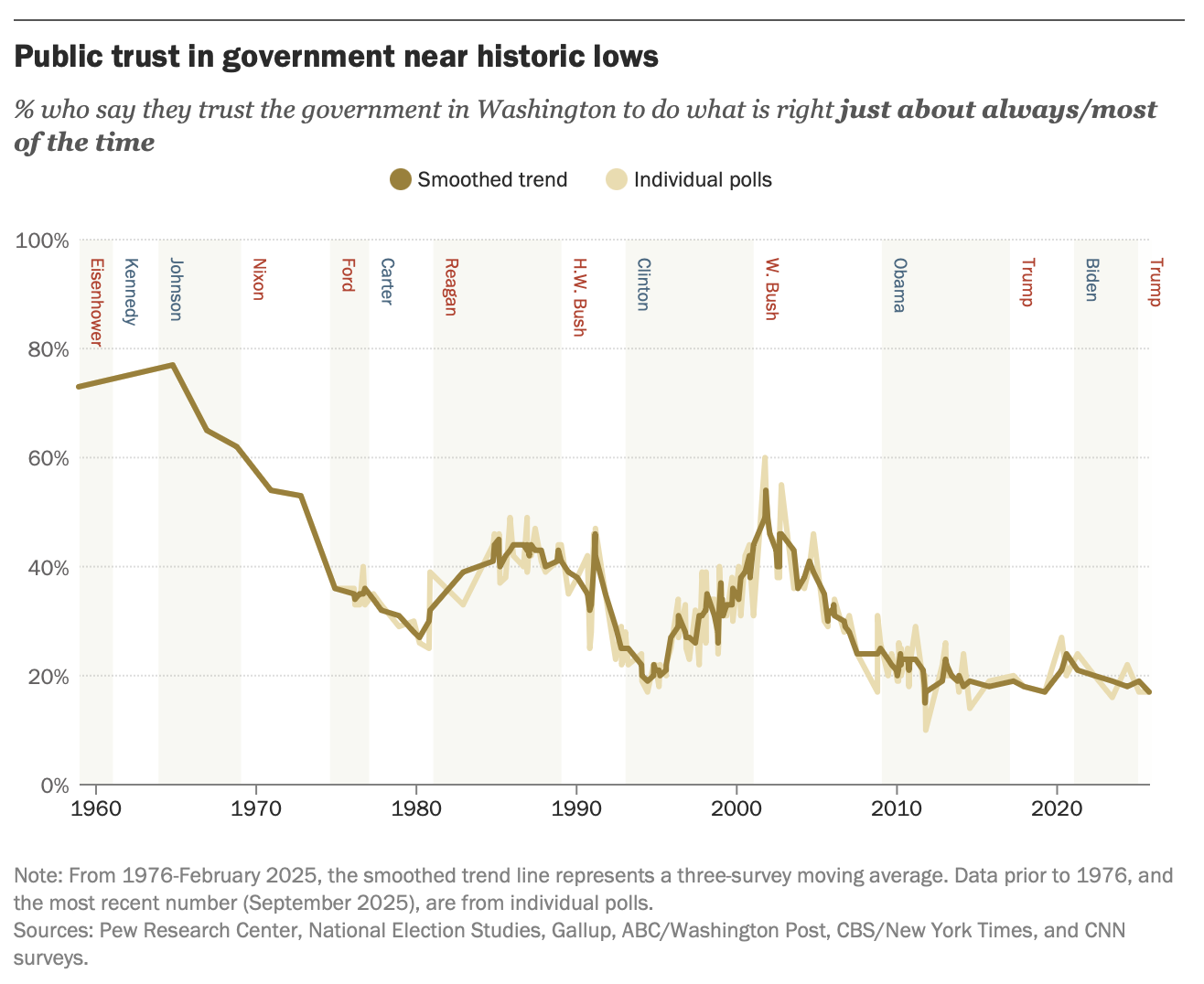
Type 2 corruption is a significant part of what is driving the loss of trust in government among the American people. This chart by the Pew Research Center shows the decline over time.
And it should be said, it is not just government. Americans have lost faith in many public institutions: religion, higher education, the legal system, big business, news media, law enforcement, recently even the military. The curves differ of course, but the same overall downward trend is notable. (Some links are provided at the end of the post.) As with the Gallup study, the situation is complicated. Lots of variables are involved, including but certainly not limited to: increasing partisanship and polarization (also a result); the fracturing of the communications and information infrastructure, first through cable TV and more recently the internet and social media (and including to my mind a concerted effort on the Right to use media for manipulation of divisions in the electorate); a new era of globalization, with all of the pressures that brings; an aging population with a delayed generational turnover in the economy; the shift from a manufacturing to a service to an information to an attention economy; and on and on.
Still, a big part of the problem is Type 2 corruption within these institutions — which is both cause and effect, a vicious cycle. Here I should say that this corruption is about high-order functioning, framing, policy-making, more than it is about bureaucratic operations. It is about institutions’ increasing inability to deal effectively with issues like those just listed, through law, through policy, through leadership, with transparency, with clarity, with fortitude. It is the failure of institutions to act for their communities, their constituencies, the people, and to be seen as doing so. This is not so much, for instance, about the hardworking civil servants in the US government, who have worked very well for decades serving the public as it is about elected officials. And that is why the dismantling of the civil service is so dangerous. (That’s not corruption; it’s assault.)
So, whence comes this inability of institutions to deal with pressing issues for the people? Well, as Plato says in The Republic, at some point the stars are just out of alignment, and even the order of the “good city” decays. Reality outruns our knowledge, our abilities, we need time to catch up, and in the interim, our institutions suffer.
Also, though, many of our institutions have over time become insular, inwardly focused. They are more concerned to serve their patrons and office holders than their publics. More focused on survival as such rather than fundamental values — in competitive sectors, there are immense pressures to grow at any costs. Exhibit A for widespread Type 2 corruption is the speed with which various institutions caved, preemptively, to Trump’s demands.
Actors within institutional sectors increasingly recycle themselves within professional ecosystems. Our public sectors form a Venn diagram of overlapping industries — government, business, news media, etc. — with the inhabitants of sectors happily circulating between bubbles. Senators serve on committees and deal with members of an industry; they leave office and become lobbyists, now talking to Senators on behalf of those same industries. A television pundit promotes a particular political vision, stokes Trump’s ego, and becomes Secretary of Defense. Without going into more examples, I suggest that a dynamic like this is happening across many sectors, and what gets increasingly diminished is actual connection with the publics the sectors should be about.
Public trust is lost when institutions forsake their missions as public trusts. And they lose that mission when they lose touch with those publics.
Every day that passes brings more bad news from Donald Trump’s unhinged behavior. His actions and dictatorial executive orders have caused immeasurable harm to our country, our citizens and residents, our friends and allies in the world community, and the standing of our country as a leader and a moral example.
Trump’s unprovoked war against Iran has caused thousands of deaths, erosion of the US military capability, and vast economic disruption to the world economy. His tariffs have increased the cost of living for Americans, and his government’s assault on Medicaid and government-assisted health insurance has forced millions of Americans into deep health insecurity. His completely unwarranted hostility and war of words and tariffs against Canada are examples of his reckless and impulsive behavior. His administration’s foolish and unscientific rejection of vaccinations, including measles vaccinations for children, has led to the largest measles outbreak the United States has seen in decades. Trump’s personal and brazen financial corruption and conflicts of interest have led to growth of his personal wealth of over $2 billion — perhaps as high as $4 billion — since his inauguration in 2025, and his family’s exploitation of their relationship to the White House is well-known as well. And Trump’s narcissistic insistence on remaking the face of our nation’s capital, his mismanagement and threats against the Kennedy Center, and his determination to proceed with a 250-foot-tall arch show a narcissistic and fundamental disregard for the traditions and values of our citizens.
Trump has failed to perform the duties of the presidency. He has sought to avoid or ignore legal orders by Federal courts. He has created a private army of violent thugs who have committed violence against innocent people in multiple cities. He has engaged in racist rants against Africans and people of African descent like the Somalis of Minneapolis and the Haitian refugees in Springfield, Ohio. He is morally unfit to be the leader of our country.
The Republican Congress has shown zero willingness to exercise its authority and to restrain the president’s actions. Fear of losing office in primary challenges appears to be more important to most incumbent Republicans than making a sober appraisal of this president’s usurpations of power, recklessness, and contempt for the institutions and norms of our democracy. And yet their most basic moral duty is to preserve our constitutional order.
Imagine an alternative political world in which we the people have taken the lead. Imagine a movement that begins with “letters of impeachment” signed by 50 million Americans, demanding impeachment and trial of Donald Trump. Imagine 50,000 people assembling every week in front of the Kennedy Center or the proposed site for Trump’s arch, peacefully resisting demolition and construction. Imagine pro-democracy demonstrations in our major cities, each involving 100,000 people in New York, Miami, St. Louis, Houston, Chicago, Seattle, Detroit, Boston, and occurring every week. Imagine every city standing up for its population against ICE in the way that Minneapolis did, forcing a retreat by Homeland Security.
And imagine an unprecedented turnout for the November election, leading to a majority in House and Senate for principled and courageous leaders like Jon Ossoff, Sherrod Brown, Joyce Beatty, and James Talarico. Majorities in Congress can provide some degree of braking capacity on Trump’s dictatorship in the final two years of his presidency.
Winning the midterms is crucial for our future as a democracy. But it is only a beginning. Reasserting the authority of Congress against a dictatorial president, finding new and unconventional ways of opposing Trump’s policies (like his assault on Canada or his threat to withdraw substantially from NATO or his determination to build a triumphal arch), and demanding accountability from cabinet officials (Blanche, Hegseth, Mullin, …) — these are the minimal steps that Democratic majorities must take. And facing the new crises that have arisen, and that Trump has waved aside (like the warnings about rogue AI technology) must be addressed. (Elizabeth Warren is ready to do this.)
And the rising economic disparities we have witnessed in our country since the 1970s must be addressed. Tax cuts for the super-rich that are paid for by reductions in Medicaid, food assistance, and other social programs are grotesque; the fact that our tech-oligarchs pay a tiny percentage of their income in taxes (3.4% according to ProPublica); the fact that corporations have many ways of avoiding revenue taxes altogether — all of these facts have contributed to the sudden transformation of the US distribution of wealth and income into an oligarch’s utopia.
A large majority of Americans now disapprove of Trump for his policies, and do not trust his promises or assurances about the future. The American public deserves better, and Trump has broken his Constitutional oath of office in numerous ways. Trump should be removed from office through impeachment, and successor administrations should learn the lesson: the Federal government exists to serve the interests of the American people within the strictures of the Constitution — not the private interests of the president and his loyal administration. And we are watching.