
For good reason, governmental corruption is much in the news now. The level of graft in the Trump Administration has reached astounding levels (I posted a brief overview a couple of months ago, and of course it has only grown since).
A widely covered Gallup poll shows Americans’ belief that government corruption is widespread has reached an all-time high: 89% average, with Democrats at 91%, Independents at 90%, and Republicans at 83%. To be sure, the data are complicated and reflect our political polarization. Gallup notes that Republicans have over time been more suspicious of government corruption than have Democrats and Independents, and during the Biden Administration 87% of Republicans thought corruption was widespread. Still, the Republican number has been edging up over the course of the current Trump term. So I think we can call this an across-the-spectrum phenomenon.
If corruption — particularly in the midst of an affordability crisis that Trump seems congenitally incapable of grasping — is what finally incenses enough people to throw the bastards out, let’s take the win. One of the most remarkable aspects of Trump’s graft is that it happens in full view with barely any attempt at justification. Graft is no longer something that the Administration gets away with, it is the primary business of the administration. The Mob has taken over. And maybe finally we the people are reacting to it.
All that said, we need to put the numbers, and the concept of government corruption, in context.
The fact is, American government today is corrupt, and has been. Not in the way of Trump’s graft — let’s call that Type 1 corruption. And we will always have Type 1 corruption with us: human nature being what it is, some people with power will abuse that power for personal gain, and the weaker the checks, the easier it is for that to happen. But, Trump has taken it to previously inconceivable levels — so maybe we should call it Type 1×1000.
He has been able to do so because of what we could call Type 2 corruption, a deeper-seated, more pervasive decomposition of government in its primary functions, an increasing ineffectiveness, a growing entropy, that has been developing for some time. The Republican Congress’s complete abdication of its responsibilities might be the apotheosis of this decomposition — at least I hope it is. But it has been a long time in the making, and feckless Democrats in Congress certainly bear some of the responsibility.
Type 2 corruption is a significant part of what is driving the loss of trust in government among the American people. This chart by the Pew Research Center shows the decline over time.
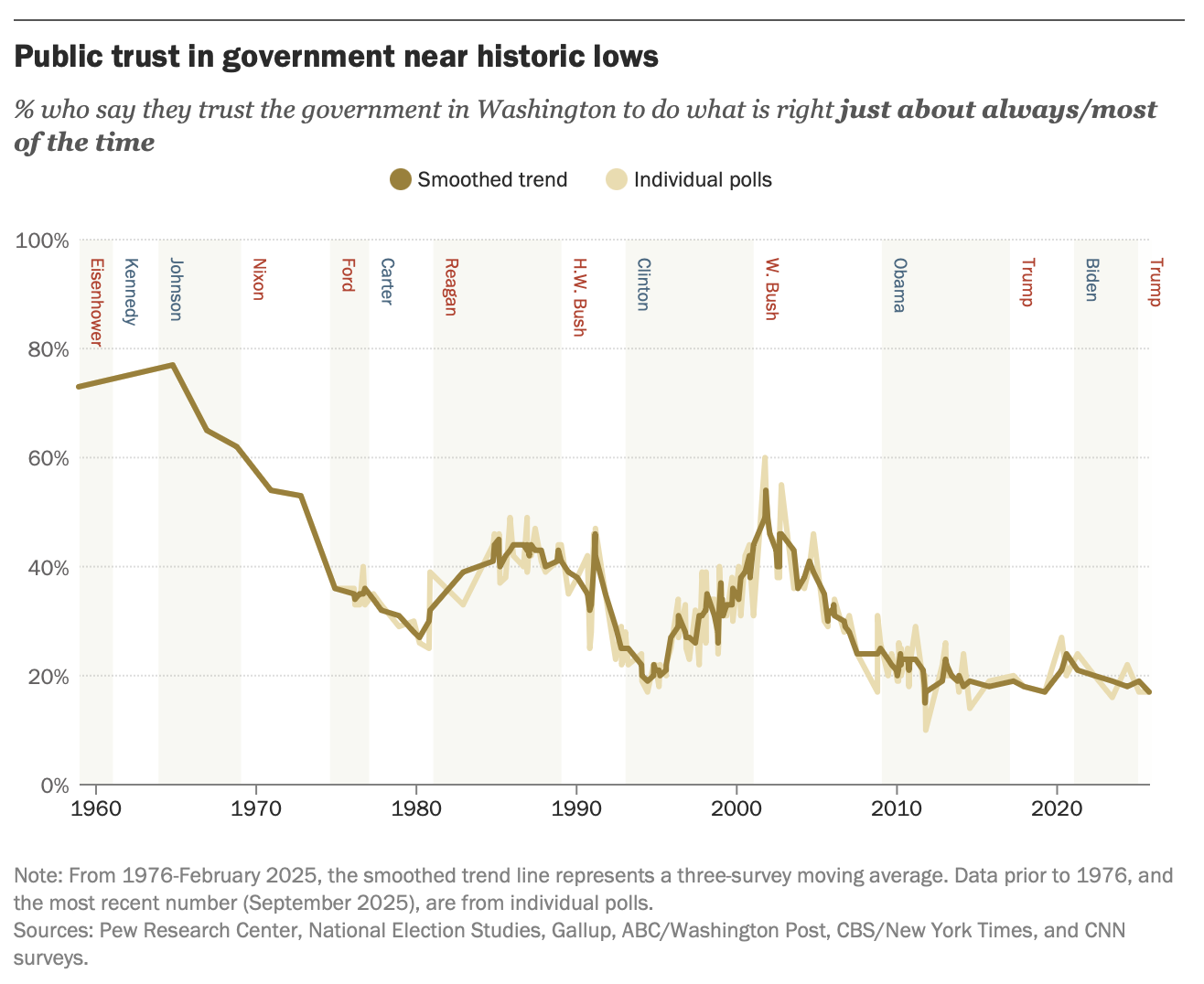
And it should be said, it is not just government. Americans have lost faith in many public institutions: religion, higher education, the legal system, big business, news media, law enforcement, recently even the military. The curves differ of course, but the same overall downward trend is notable. (Some links are provided at the end of the post.) As with the Gallup study, the situation is complicated. Lots of variables are involved, including but certainly not limited to: increasing partisanship and polarization (also a result); the fracturing of the communications and information infrastructure, first through cable TV and more recently the internet and social media (and including to my mind a concerted effort on the Right to use media for manipulation of divisions in the electorate); a new era of globalization, with all of the pressures that brings; an aging population with a delayed generational turnover in the economy; the shift from a manufacturing to a service to an information to an attention economy; and on and on.
Still, a big part of the problem is Type 2 corruption within these institutions — which is both cause and effect, a vicious cycle. Here I should say that this corruption is about high-order functioning, framing, policy-making, more than it is about bureaucratic operations. It is about institutions’ increasing inability to deal effectively with issues like those just listed, through law, through policy, through leadership, with transparency, with clarity, with fortitude. It is the failure of institutions to act for their communities, their constituencies, the people, and to be seen as doing so. This is not so much, for instance, about the hardworking civil servants in the US government, who have worked very well for decades serving the public as it is about elected officials. And that is why the dismantling of the civil service is so dangerous. (That’s not corruption; it’s assault.)
So, whence comes this inability of institutions to deal with pressing issues for the people? Well, as Plato says in The Republic, at some point the stars are just out of alignment, and even the order of the “good city” decays. Reality outruns our knowledge, our abilities, we need time to catch up, and in the interim, our institutions suffer.
Also, though, many of our institutions have over time become insular, inwardly focused. They are more concerned to serve their patrons and office holders than their publics. More focused on survival as such rather than fundamental values — in competitive sectors, there are immense pressures to grow at any costs. Exhibit A for widespread Type 2 corruption is the speed with which various institutions caved, preemptively, to Trump’s demands.
Actors within institutional sectors increasingly recycle themselves within professional ecosystems. Our public sectors form a Venn diagram of overlapping industries — government, business, news media, etc. — with the inhabitants of sectors happily circulating between bubbles. Senators serve on committees and deal with members of an industry; they leave office and become lobbyists, now talking to Senators on behalf of those same industries. A television pundit promotes a particular political vision, stokes Trump’s ego, and becomes Secretary of Defense. Without going into more examples, I suggest that a dynamic like this is happening across many sectors, and what gets increasingly diminished is actual connection with the publics the sectors should be about.
Public trust is lost when institutions forsake their missions as public trusts. And they lose that mission when they lose touch with those publics.
https://news.gallup.com/poll/713933/record-high-say-government-corruption-widespread.aspx
https://news.gallup.com/poll/712322/confidence-higher-education-slips-back-slightly.aspx
https://news.gallup.com/poll/695762/trust-media-new-low.aspx
https://news.gallup.com/poll/712436/confidence-institutions-remains-near-time-low.aspx

