
As I mentioned here, I am reflecting on “government of the people, by the people, for the people” as a formula to understand democracy. We will take the phrases in reverse order. So let’s begin: “government for the people.”
This phrase articulates the people as the beneficiaries of the actions of the government. That government should be for the people has ancient roots — indeed, it can be seen as a necessary criterion for any government that is just, or, maybe better, “righteous,” to avoid modern connotations of the former term. The ruler who does not work for the good of the flock could hardly be called righteous. In the Old Testament, books of the prophets might be read as evaluations of the kings of Israel in terms of this criterion, understanding that “for the people” meant that the rulers were judged on the degree to which they either facilitated or hindered the development of the people as the chosen of YHWH (which development also brought with it certain material benefits). The Hindu scriptures discuss the virtue of rajadharma, the duty of the ruler, basing it on care for the people, saying that the ruler’s dharma rests with the subjects’ happiness. In Chinese thought, the Mandate of Heaven conferred the right to rule but conditioned it on beneficence toward the people. Confucius and Mencius and later philosophers amplified this theme. Examples could be further multiplied. The upshot is, where the people do not thrive, all things equal, the government cannot be called righteous.
J.S. Bach’s beautiful “Schafe Können” movement from the Hunt Cantata (BWV 208) captures this sense of governance:
Schafe können sicher weiden
Wo ein guter Hirte wacht.
Wo Regenten wohl regieren
Kann man Ruh’ und Friede spüren
Und was Länder glücklich macht.
Sheep may safely graze
Where a good shepherd watches over them.
Where rulers are ruling well,
We may feel peace and rest
And what makes countries happy.
So, government for the people is a basic criterion for legitimate government; anything else is nothing more than exploitation, control, bondage. How we define what is for the people is at least in part culturally and historically contingent: for instance, the Aztec practice of human sacrifice, which we find horrific, could nonetheless be seen by Aztecs as an expression of the rightful order of the people with respect to nature and the divine. But if an Aztec priest were to take a bribe intended to influence the choice of sacrificial victim — that would be exploitation and a corruption of the order.
At a minimum, then, legitimate government must be for the people. That the government of King George III did not meet this criterion for the American colonies, according to the Declaration, justified dissolving the political bands with England: “The history of the present King of Great Britain is a history of repeated injuries and usurpations, all having in direct object the establishment of an absolute Tyranny over these States.” It is not only that the people were not sufficiently represented in a democratic (or republican) sense, it is not just that the king “usurped” their rightful place, it is also that the king inflicted “repeated injuries” upon them, as most of the enumerated complaints lay out. It is that the king failed to represent, to stand for, to enact, the people’s good, and that he inflicted real harm. He failed the test of righteousness. And part of the Colonists’ complaint was that in this respect, they were treated unfavorably, unjustly, compared to the inhabitants of Great Britain.
Today we face a near-complete failure of government for the people at the federal level (except for those pockets of dedicated civil servants who continue to work for public good despite Trump’s all-out assault on our government). Trump’s government is not for the people, it is for the wealthy. This is to be sure a long-term trend that pre-dates Trump, as this graph from the Congressional Budget Office shows:
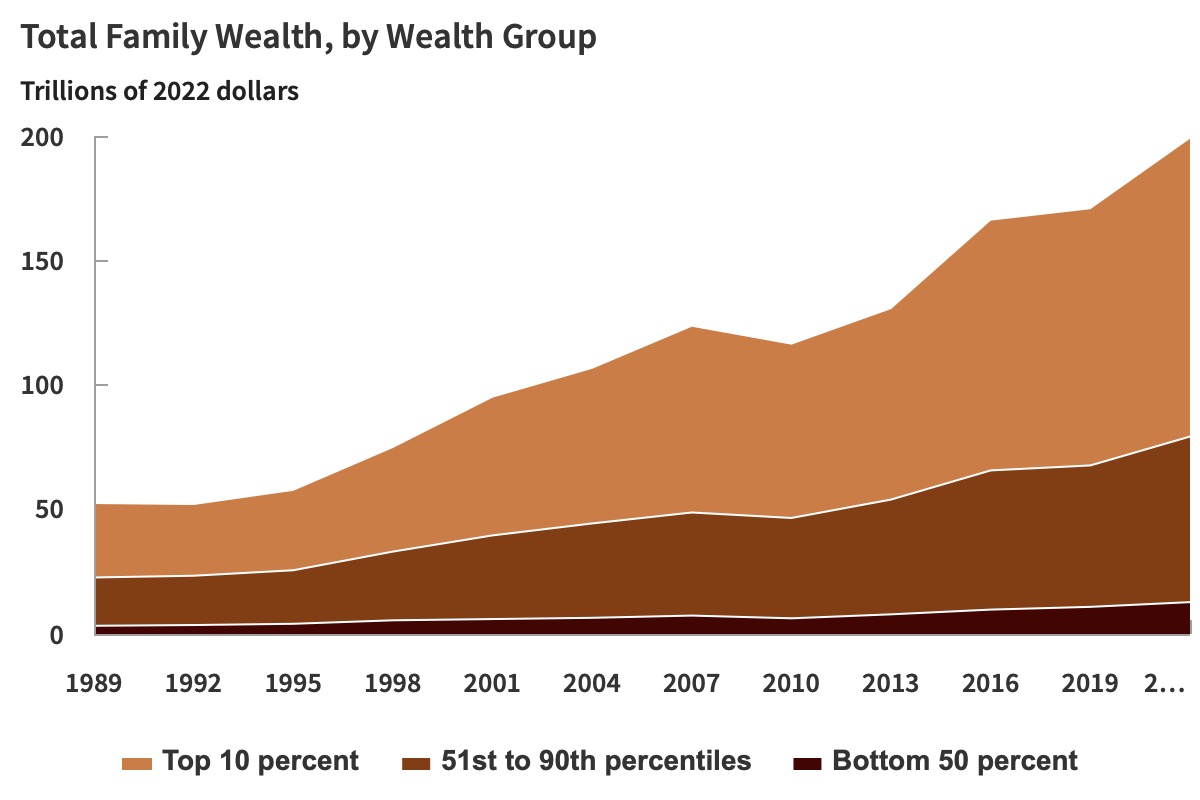
That is only one measure of our descent into oligarchy and oligophely, government by the few and government for the few. That descent fuels current populism on both the Left and (misguidedly) the Right.
Today, of course, government is for Donald Trump. That is exactly how he treats it: as his personal property. (See Robert Reich here and Tom Nichols here for variations on this theme.) It is hard to overestimate the degree to which Trump & Co. has exploited the American people — to the tune of billions of dollars and counting in direct benefit, let alone hundreds of millions at least for his vanity projects such as the ballroom, the reflecting pool and the arch. And what are we to make of the Iran war in this respect? A minimum of $40 billion to date in direct costs (some estimates much higher), with no end in sight, and estimates of costs to American consumers well over $100 billion in shortages and rising prices. The war might not be corruption in the strict legal sense, such as violating the emoluments clause of the Constitution. But it is fair to call the level of incompetence and willful ignorance corruption in another sense; it is rot at the very top, and we will be making up for it for years to come. And none of this is to mention other evils that Trump is inflicting on the people through executive orders of all sorts, largely to gratify his sense of power and to assuage his fragile ego. To return to the Hebrew prophets:
Woe be to the shepherds of Israel that do feed themselves! Should not the shepherds feed the flocks? Ye eat the fat, and ye clothe you with the wool, ye kill them that are fed: but ye feed not the flock. The diseased have ye not strengthened, neither have ye healed that which was sick, neither have ye bound up that which was broken, neither have ye brought again that which was driven away, neither have ye sought that which was lost; but with force and with cruelty have ye ruled them. And they were scattered, because there is no shepherd: and they became meat to all the beasts of the field, when they were scattered. (Ezekial 34:2-5, KJV)
All of which is to say that our anti-Trump rhetoric can fall a little short. “No Kings,” fine — it is a pithy, memorable and clearly engaging term that goes directly at Trump’s aspirations. But according to Lincoln’s formula, Trump does not even meet the minimum legitimation threshold for a genuine king.
One of the things we said in the previous post was that democracy, functioning properly, is a check against this kind of injustice, exploitation and corruption. That said, I think it is a sad and possibly dangerous fact that the idea of government for the people dominates our political discourse, at the expense of the rest of Lincoln’s formula. “What’s in it for me? How can government help me?” are the constant refrains. As if when we vote it is like signing up for a benefits package. We might as well call it an auction. And in an auction, we know who the winners are likely to be.
At least that is the tone of so much political rhetoric, punditry, reporting. Trump’s recent ploy to give Americans a $5000 dividend if we re-elect a Republican House and Senate puts an exclamation point on such discourse. Long gone, it can seem, are the days of John F. Kennedy’s “Ask not what your country can do for you; ask what you can do for your country.”
Fortunately, this is not entirely so. The vast majority of us take jury duty seriously; we rise to the aid of others when disaster or ICE strikes; many of us regularly contact our representatives or attend town halls; we participate in protests; we sign petitions as a matter of course; and we vote, albeit in too-low levels.
And that points us toward the next post, “government by the people.”
 Affirming Democracy, Gathering Resistance