
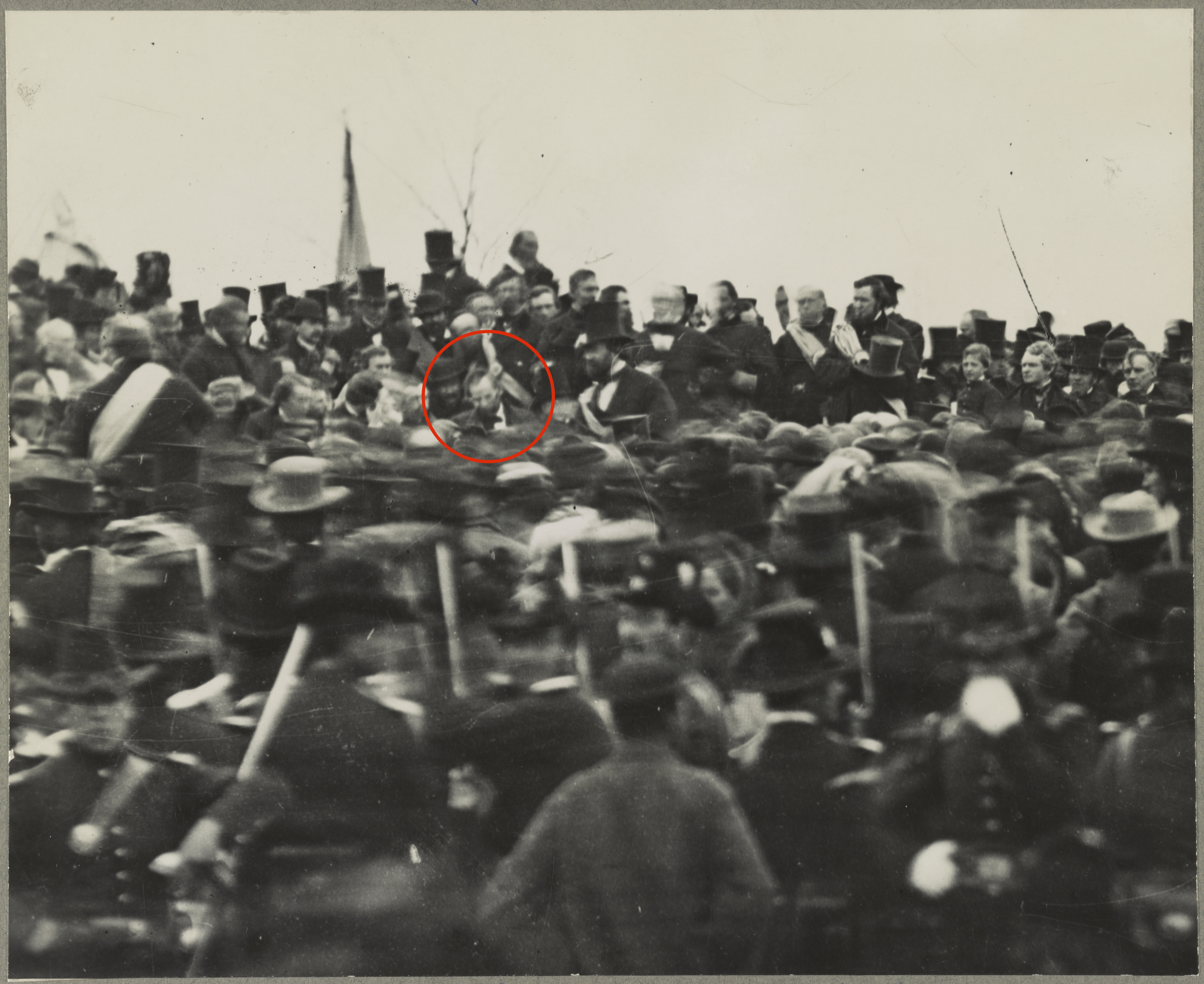
I have been re-reading Garry Wills’s 1992 masterful and transformative work, Lincoln at Gettysburg.1 Wills takes a deep dive into the Gettysburg Address: its place in the history of funerary oration, in the burial culture of mid-19th-century America, in the intellectual tradition of American Transcendentalism, in the development of modern rhetoric2, and most importantly for our purposes, in the re-shaping of American political self-understanding, helping to pave the way for the “Second Revolution” amendments following the war. The subtitle of the book is “The Words That Changed America,” and Wills makes a strong case. I highly recommend it. It provides important clues for how to think about what I have been calling Lincoln’s “formula for democracy.”
Wills dispels the popular myth that Lincoln’s address was so surprisingly short that the on-site photographer was caught off guard and only managed to capture the president on camera when he was descending the dais.3 There was no “surprise.” Lincoln was not the “main event” – that honor belonged to the beloved orator Edward Everett, who spoke for two hours. Lincoln’s sole job was precisely to dedicate the cemetery where the Union dead were buried, no more and no less. A lengthy “address” rather than a brief dedication would have been out of place and unseemly. The real miracle is that Lincoln transformed a dedicatory statement into an “address” that “transformed America.”
There is of course much more to the address than the concluding formula, though much in the address points toward that formula. Lincoln did not invent the formula out of whole cloth. Precursors can be found in Daniel Webster, whom Lincoln revered, and perhaps even more clearly in the speeches of the American Transcendentalist Theodore Parker, who, reflecting on the Declaration of Independence, said this:
By Democracy, I mean government over all the people, by all the people, and for the sake of all the people . . . . This is not the democracy of the parties, but it is that ideal government . . . whereunto mankind slowly draws near.
Lincoln was in possession of a collection of Parker’s writings, having been given them by his law partner, William Herndon, who was an acolyte of Parker. Parker was a staunch and vociferous abolitionist; he was also a believer in the superiority of the white race. Nevertheless, he believed that as human beings, Blacks had the same natural rights as people of any race. As a Transcendentalist, he contended that the United States was constituted so as to realize an ideal and that that ideal had been articulated in the Declaration’s claim of equality and unalienable rights – specifically, the right to life, liberty and the pursuit of happiness. In that respect, if not in others, all were equal.
Lincoln was no Transcendentalist philosopher. He was a political animal and strategist — though also a deeply thoughtful and thoughtfully moral person. And in his own way, as Wills makes clear, he had been working over years toward an understanding similar to Parker’s, perhaps influenced by him, but certainly carried forward by his own moral-political logic. Wills traces this development through the Lincoln-Douglass debates, through Lincoln’s correspondence, and through a variety of speeches up to the 1860 election and after.
The essence of this development was this:
The Declaration, not the Constitution, established the United States as one nation defined by the ideals of its second sentence. Lincoln was building on the work of his hero Webster and others. It was the Declaration, not the Constitution, that established the American people as “one people” that would “assume among the powers of the earth the separate and equal station to which the laws of nature and of nature’s God” entitled them. The Constitution was a particular form of government adopted by that people, as had been the Articles of Confederation. And so it was the Declaration that set forth the ideals by which the Constitution had always to be judged and corrected. The Constitution was shaped by necessary (or seemingly necessary) compromises, including the at-once enabling and debilitating compromise with slavery. (Ancillary to this is that, for Lincoln, we the people – not just the people of the South – were culpable for the sin of slavery, something we still struggle to deal with, as the present assault on “wokeness” makes clear.) Those compromises were historically contingent; they were by their nature provisional steps along the way in the ongoing task of realizing the ideals of the Declaration, the ideals according to which we had declared ourselves “one people.” In other words, the Constitution was meant to be amended, and amended in progress toward the ideals of equality and unalienable rights.
Lincoln found in the Constitution itself evidence of its authors’ own understanding of this situation (e.g., it included abolition of the slave trade). In other words, its authors knew – or at least what came from their collective chartering of a new government clearly meant in full view – that they were making a pact with a pernicious institution in order to make a government. That they deemed this compromise — and those that sustained it in the first four-score years of the new government’s existence – worthwhile is and should be open for debate.4 Theodore Parker thought it was not and was prepared to sacrifice the Union for the abolition of slavery. Not so, Lincoln. But these are questions I will leave to another time.
Thus we are, as Lincoln says at the beginning of the Address, a nation “dedicated to a proposition” (indeed, a world-historical proposition: “testing whether that nation, or any nation so conceived”). We are not a nation defined by our ethnic inheritance, our racial constitution, our familial ties — all of those things that “blood loyalty” demagogues like J.D. Vance want us to believe. No, we are a nation about a commitment to an idea, an idea of equality and freedom. Indeed, it is hard to overstate how innovative and profound this idea was, in both the Declaration and the Address. Neither is this an idea without any downsides, and that, too, could be for another time.
But it is an idea well worth recovering and defending. As William Hoagland points out in this thoughtful piece, “Separation of Power,” our over-reliance on appeals to the Constitution is ill-founded if we restrict ourselves to the Constitution of 1789 — in so many ways an anti-democratic document – as opposed to the Constitution re-shaped by the 13th, 14th, 15th Amendments and many that followed.
Equality and unalienable rights require a certain approach to government, although perhaps not a specific form of government. An argument for democratic government – whether pure, representative, republican, etc. – is that it is the approach most likely to ensure that our equal rights are obtained and sustained, as I discussed in a previous post.
Lincoln’s formula, “government of the people, by the people, for the people” condenses this into a mantra, a mantra I wish we would all meditate on. But let’s wrap this post up by noting that it’s a mantra that occurs in a dedication at a time when the democracy dedicated to a proposition was under threat. He concludes the Address in this way (paragraph breaks added for emphasis):
It is rather for us to be here dedicated to the great task remaining before us
—that from these honored dead we take increased devotion to that cause for which they gave the last full measure of devotion
—that we here highly resolve that these dead shall not have died in vain
—that this nation, under God, shall have a new birth of freedom
—and that government of the people, by the people, for the people, shall not perish from the earth.
In upcoming posts, we’ll explore each of the prepositional phrases in that final clause. And we will take the trio in reverse order, because therein lies an increase in our understanding of what democratic government is about.
1It brought a smile to my face to be reminded that Wills dedicated the book to The Great Expectations Bookstore in Evanston, IL, of which I have my own fond memories. Sadly the store closed in 2001.
2For another, brief rhetorical analysis of the Address, see this post by Oxford University Press.
3The photo sometimes used in conjunction with this myth — the photo I’ve used to illustrate this post — has been shown by analysis to have been taken about three hours before Lincoln actually spoke. It is one of only two photos of Lincoln at Gettysburg, and in both he is simply part of the crowd.
4The 1619 Project is a critical contribution to this discussion, questioning the entire premise of locating our founding in the Declaration.


Gary, it’s so good to hear your thoughts about Lincoln and the Gettysburg Address. I revere both these pieces of our sometimes tortured history. (I visited New Salem and Springfield many times as an adolescent.)
I also loved the Great Expectations bookstore during the three years I lived in Evanston during my first job.
Thanks for this outstanding piece!
Dan
Pingback: Government “for the people” | Affirming Democracy, Gathering Resistance