
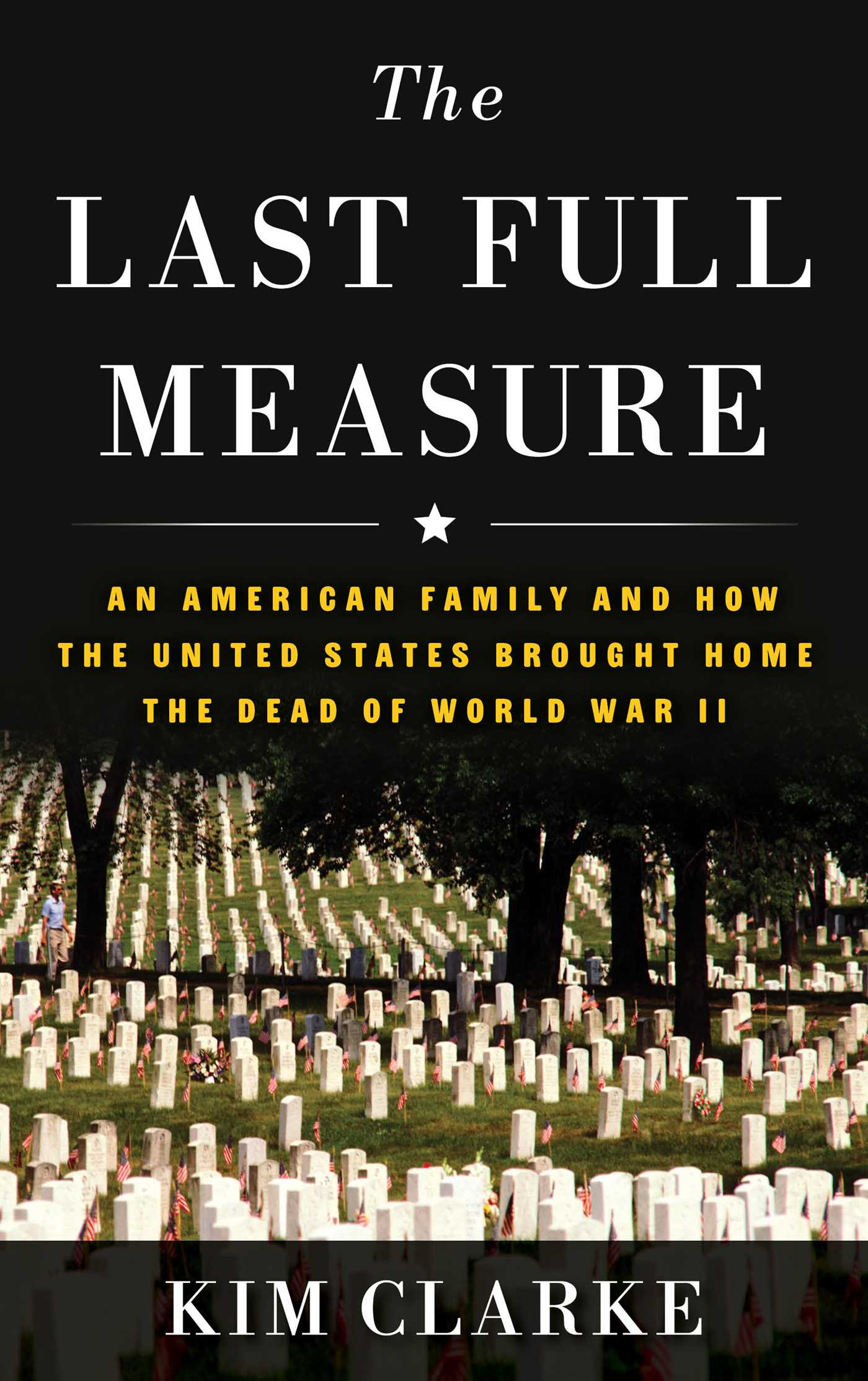
The MAGA Movement is intent on silencing authentic, responsible historiography of America’s past. This has been going on at least since DeSantis was elected governor of Florida (indeed, its roots go much farther back in the conservative movement). The latest salvo is the Trump Administration’s attacks on the Smithsonian Institution. This is childish stuff, and it does not bode well for our national well-being. As the well-known inscription on the William L. Clements Library at the University of Michigan says, “In darkness dwells the people which knows its annals not.”*
Fortunately, there are serious grown-ups who continue to do fine and important work to expand the American annals. I’m very happy today to draw attention to an excellent example, by our friend and colleague Kim Clarke, whose The Last Full Measure: An American Family and How the United States Brought Home the Dead of World War II has just been published. The book is an informative and moving account of a forgotten episode in US history. Clarke is an outstanding researcher and writer, and she weaves together a thorough sociopolitical history with a history of her own family.
At the center of the story is her grandfather, Delbert Trueman, who, very sadly, was killed on his first combat mission, when the B24 bomber on which he served as a gunner was shot down over Austria. The book follows Delbert from his early life to this moment of supreme sacrifice, and on to the journey his remains made — from being buried by German soldiers, to being moved after the war and reinterred in the temporary American military cemetery at St. Avold, to his finally being brought home to Indiana years after the war ended. His postmortem journey was typical of those Americans who gave their lives in Europe, North Africa, and the Pacific.
Delbert’s story is not the only one recounted — indeed, much of the book proceeds through the biographies of individuals who were involved in the complex process of returning or burying the dead. We learn about Colonel Robert Harbold, who organized the entire massive effort to deal with the dead; about Lt. Michihiko Hayashida, who with his Japanese-Americam family was sent to an internment camp but who then served in the American Graves Registration Service identifying and relocating the dead; about Karl Kasca, a mortician who dealt with the remains of thousands of the deceased. We learn about the other members of Delbert’s crew and their destinies. And we learn about Kim Clarke’s own family and their part in the history of this country that we share.
We learn about the horrors of war: the terrible disfigurements that made identification of the dead so difficult. Clarke writes:
American soldiers died hiding behind trees, in ditches, under rubble. And that instinct—the instinct to survive—became, in death, an obstacle to being found.
In the end, I came away with the feeling that it was nothing short of a miracle — an organized miracle — that so many of the dead were found and identified.
The US was the only nation to return its dead, and the move was not without controversy. Some thought that bodies should be left in peace, some had religious objections, some thought the funds would be better utilized to help the families of the dead or those who had returned from the war wounded. These debates played out in the press and in Congress, and each family had to make its own decision. Ultimately, about 60 percent decided to bring their loved ones back to th US.
The first overwhelming impression I have from this book is of the care, the dignity, the responsibility, and the lengths to which those charged with recovery went about their work:
There was an abiding air of deference as troops uncovered remains. They had to pay close attention to detail as bodies—damaged, decomposed—were lifted from the earth. There could be no overlooking anything, because accurately identifying a soldier’s body meant everything. Army regulations made it clear: “Graves registration is not an easy task at best. It is not a task to which troops are assigned for disciplinary purposes. Rather it is one for which the highest type of military personnel should be chosen.”
Each body returned to the US was accompanied by an escort, and both escort and escorted were referred to as “passengers,” had tickets, and were treated with respect. These were, in other words, persons on their way to their final resting places.
The second overwhelming impression is of individual American citizens meeting the moment and doing what they knew was needed, whether that was the warriors like Delbert Trueman and his fellow crewmen, doing their level, courageous best in the heat and terror of battle, or those who day after day after day faced the gruesome task of location, identity and transport of the mangled and decomposing dead, not just so they had not died in vain, but to ensure that they, as fellow servicemen and citizens, were treated with all of the dignity they deserved. In brief, real, serious adults doing the work of real, serious adults. And their work adds a layer of meaning to our founding phrase, all men are created equal.
Such sensibilities are very far from where we are now, when we have a Secretary of Defense obsessed with testosterone levels and a president so willfully oblivious of the realities of war that he constantly flip-flops and temporizes when American — and Iranian — lives are at stake. Kim Clarke has done us a service, not only in extending America’s annals, but in giving us one more reminder of how we Americans did brave things in the face of danger and difficulty.
And, perhaps we can say that we still are that people. We’ve seen it in the courage of Minnesota and Illinois citizens, in the steadfastness of election workers in the face of illegitimate pressure, in the journalists who continue to probe for truth, in the students who risk the wrath of their universities and their government when they protest, in the judges of all political persuasions who uphold the law and the Constitution. We, too, can and must carry forward the legacy of those who have gone before.
*The statement was written by U-M history professor Ulrich B. Phillips in 1923, expressly for the facade of the Clements. It stands in conversation with another statement by Phillips composed for the facade, “Tradition fades but the written record remains ever fresh”

