
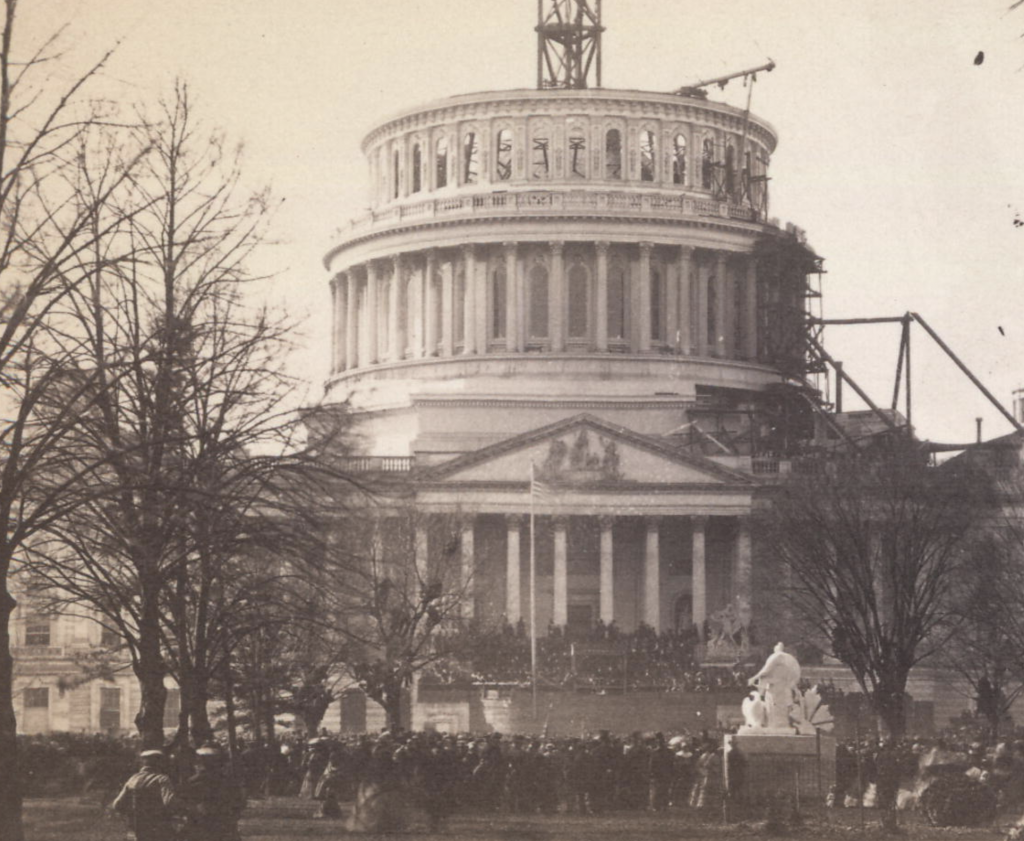
Photo of Lincoln’s First Inauguration
Well, here we are. We are sad, we are afraid, we are determined, we are hopeful, and we do not know what the future holds. But, here we are, and we have good reasons to mark this occasion.
Who we are has been a theme of my recent posts, but today I want to take a look at what we are, because that also bears on where we are and where we go.
Today, we have been “here” for 250 years — meaning that 250 years ago today we announced that we were to “assume among the powers of the earth, the separate and equal station to which the Laws of Nature and of Nature’s God” entitled us, as the Declaration says.
Of course, we have been “here” for longer than that, in so many ways. I am writing this in New York City, the land of the Munsee Lenape, who inhabited what is now Manhattan Island for many generations before the arrival of Dutch settlers in 1624, before the English took over in 1664, before the arrival of Europeans in Florida in 1565, in North Carolina in 1587, in Virginia in 1607, in Massachusetts in 1620. Before the introduction of slavery in 1619.
But we have been here as a state for 250 years, today. Not, in political-science terms, a nation-state, because we were already nationally and ethnically diverse, but a civic state, a constitutional state, as the Declaration, the Articles of Confederation, and the Constitution all made clear.
So now, starting now, where does the state of the United States go? Of course there are many matters of activism, politics, elections, and governance that we will need to address in the days and weeks ahead. But in broad terms, where?
We are concerned and afraid. We are afraid that, as a state, we are losing our soul, our founding ideals and principles, our raison d’etre, our constitution, i.e., that which constitutes us. We are afraid that as a state, we are becoming a mere simulacrum, a mere parody, of our stated and unstated principles.
And, we are afraid of our divisions, our polarization, our seemingly intractable separations. We do not see how we can come together. Talk of actual dissolution of the Republic and of secession from the Republic has been on the rise, and while it might largely be rhetorical, it is telling nonetheless.
There is too much here to unpack in one post, so I hope to do more in the future. But let’s start today on the eve of the greatest rupture in our history — the eve of the Civil War, and Abraham Lincoln’s First Inaugural Address.
At the time of his inauguration, seven Southern states had seceded from the Union — all acting on the basis that a Lincoln presidency constituted a grave threat to their fundamental interest, their interest in slavery.
In his address, Lincoln chooses not to recognize this situation; he ignores secession and acts like a parent deciding to ignore an unruly child. He talks as if secession is a possibility but leaves the door completely open for those states to reverse their decisions. And one of the reasons for this is that he viewed the idea of secession as having no standing either under the constitution or under what we might refer to as natural law.
Lincoln does two important things in the address: he constructs a powerful legal brief concerning the impossibility of legitimating secession, and he appeals to larger forces — friendship, history, and memory among them — that unite the American state.
The legal brief consists of three arguments:
- Secession would be baseless. Slavery, no matter what, is written into the Constitution; Lincoln as president is duty-bound to uphold the Constitution; so his Administration represents no particular threat to slave-holding states.
- Secession would be illegal and unconstitutional. The Constitution is a contract that was adopted in perpetuity; parties to a contract have no right to violate the contract. Moreover, the Constitution of 1787 did not in itself constitute the American state, it was an act of the already unified American state — a unified state that dated back to the Declaration and Articles of Confederation (and perhaps even to the Articles of Association of the First Continental Congress in 1784). No state can simply forsake its own statehood, its own constitution.
- Secession would be undemocratic. In a state that is a democratic republic, on any and all issues there will be a majority position and a minority position. Either the majority position will prevail or the minority position will win over enough to become the majority. A party dissatisfied with an outcome is not at liberty simply to pack up and leave: to do so would make majority rule — the fundamental mechanism of democracy — empty and hence democracy meaningless.
The other main point can be best represented by Lincoln’s famous concluding paragraph, beginning with the poignant “I am loath to close” — as if continuing to talk to the people could stave off the inevitable — and continuing:
We are not enemies, but friends. We must not be enemies. Though passion may have strained it must not break our bonds of affection. The mystic chords of memory, stretching from every battlefield and patriot grave to every living heart and hearthstone all over this broad land, will yet swell the chorus of the Union, when again touched, as surely they will be, by the better angels of our nature.
So, that is Lincoln’s gloss, shall we say, on what happened 250 years ago today. We know what came next, and how it constituted a second revolution.
Today, the larger issue that we face is the first that I mentioned above, the fear that we will lose our principles, our constitution. And we are in the historically unique situation that we face that fear because of the nature of the enemy to the constitution, the enemy to the state. Lincoln confronted the illegal secession of a third of the Republic. We face a government that is dead set on destroying the state as it has been, destroying our Constitution as well as our unwritten constitution.
We often think of “state” as meaning the government. But the government is not the state, it is not us. It is no more than the agent of the state. Louis XIV might have stated the fundamental formula of an undemocratic monarchy when he said, “L’Etat c’est moi,” a perfect statement also of Tump’s mindset. But the formula of our democratic republic is “we the people” are the state. What happened in 1776 is that we the people assumed our separate and equal station among the powers of the earth.
Now we the people, the American state, is under assault by those whose duty is to protect it. The massive efforts to disenfranchise millions of Americans in order to attain tyrannical power is example number one.
So, it is our duty to protect the American state. Get out and protest. Work locally and nationally to protect our elections. We do not know what the next few months will hold, but we must understand what is at stake and do what it takes — and like our forebears “mutually pledge to each other our Lives, our Fortunes and our sacred Honor.”
Happy 250, America!


Gary, such an important set of reflections for today, July 4, on the 250th anniversary of our founding. I agree with you — returning to Abraham Lincoln is so important at this point in history, and the First Inaugural Address is a crucial step. “We must not be enemies” … “the mystic chords of memory” … “the better angels of our nature”. Lincoln’s vision here is an appeal to a divided nation to recover the values that hold us together. It is a beautiful and powerful vision. Unfortunately, in Lincoln’s setting in 1861, there was the sad underlying reality that the two sides did not agree about a crucial value, the value of universal human equality. Thank you!
Pingback: Why democracy? | Affirming Democracy, Gathering Resistance