I’ve been thinking more about Ulysses and Leopold Bloom’s comment about history. “History,” he says, “is no life for man and woman!” “History means violence and hatred — the opposite of love. Let’s see if we can unpack this a bit more.
A little background: Joyce composed Ulysses during WWI — the war of which his fellow Irish poet, W.B. Yeats, said “mere anarchy is loosed upon the world/ the blood-dimmed tide is loosed/ and everywhere the ceremony of innocence is drowned.” Surely, this was history at one of its low points. Joyce also composed Ulysses during his self-imposed exile from Ireland, which during his youth had already seen Troubles in the struggle for independence from Great Britain. And, in that exile, he feared for the health of his daughter and struggled in his relationship with Nora. Leopold Bloom is not Joyce, but one can see where frustration with “history” might come from and might shape a narrative.
When Bloom contrasts history with love, with life, with the lives of “ordinary” people (and Ulysses is the account of one day in the lives of “ordinary” people) in part he is engaged in the modern project, the Enlightenment project, of elevating the dignity of the human individual. The struggles of nations, the march of empires — we might say today, the capturing of markets, the spectacles of so-called influencers — none of this can have worth without value that redounds to individual humans. But “history,” in the sense that Bloom uses it, inverts that relation. “Make America Great Again” inverts that relationship. In those inversions, the individual derives value from larger powers: the march of history, the nation, the Dear Leader.
And yet . . . and yet. There is another sense in which we cannot eschew, cannot avoid, history. Obviously, of course, things “happen” — and happening after happening is in some sense history. But history in a larger sense, in the sense of organizing lives and actions — the sense of history that Bloom is talking about — also needs, deserves our attention.
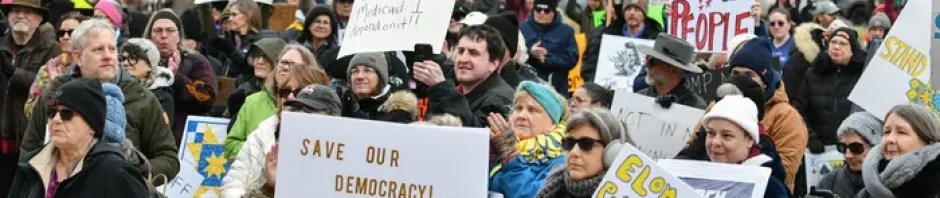
My question is this: if we are committed to democracy—a form of government that at least in principle is all about the dignity of individuals—can we eschew “history”?
Hegel thought that the march of history was the march of freedom. But the march does not happen on its own. And, if we are committed to human dignity and if the recognition and acceptance of human dignity for all is not yet accomplished, are we not then committed to history? Does not a commitment to democracy entail commitment to history, for as long as democracy is not complete?
As Lincoln understood, the Declaration charges us. In the Gettysburg Address, he calls on us to be dedicated to “the great task remaining before us”—ultimately, the task of “government of the people, by the people, for the people.” To engage in that great task is to engage history as a project.
And perhaps then the question becomes, “at what cost”? At the cost of the love that Bloom talks about? Maybe “history” is a necessary but dangerous companion. If “history” or even “democracy” causes us to lose our sense of humanity for the sake of some larger idol — well, then Bloom is right,
 Affirming Democracy, Gathering Resistance