I’ve been thinking about our discussion last night, which was a very good one.
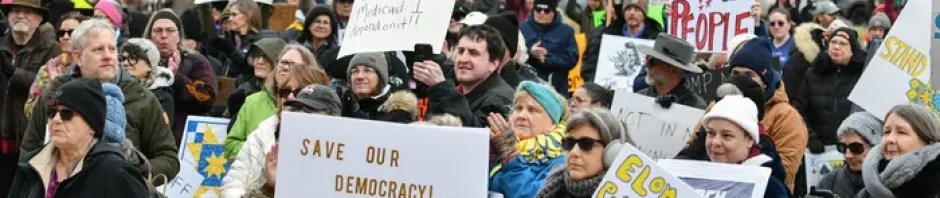
One thing that became more clear for me is that we face two existential crises in the United States, not just one. Most visibly, we witness daily the extension of lawlessness and authoritarian use of power by our Federal administration. So we are rightly concerned and anxious about the destruction of our democratic institutions and our rights as free citizens.
Also highly visible, and intertwined with the first crisis, is the rise and spread of hate-based activism, white supremacy, anti-Semitism, anti-Muslim bigotry, hatred of immigrants, and punitive antagonism to non-conformant people along lines of gender and sexuality. We see evidence daily of young people being radicalized along the lines of right-wing extremism, with neo-Nazi groups and other extremist rallying calls finding increasing support. (Recent reports indicate that Discord has become an important hub for right-wing radicalization of teenagers.) As documented by the Southern Poverty Law Center (link), hate groups are gaining followers and finding new ways of advancing their goals.
As citizens of a democracy based on equality, we are faced with two fundamental challenges: to resist the encroachment of governmental lawlessness and authoritarian measures; and to find ways of reducing the potency of hate-based recruitment and to increase the resilience of the majority of us against hate in our communities.
Several avenues seem especially promising in response to the threat of hate-based mobilization. One is the role played by community-based organizations that have presence across communities and that convey the values and messages of equality, toleration, and trust across groups. A good example in Michigan is ACCESS, a civic organization based in Dearborn that has consistently advocated for cross-community friendship and partnership and has advanced the values of community solidarity across lines of religion, ethnicity, and race. Organizations like ACCESS can be an important line of defense against extremism, and they can have positive effects on the young people in the various communities they embrace.
A second avenue is the language and actions of our political leaders. We need political leaders who speak passionately and truthfully about the values of a multi-racial, multi-ethnic, multi-religious community. I am an admirer of Debbie Dingell. But I think she and her colleagues — including the rare Republican who still believes in political and civil equality — need to be using their skills to communicate the democratic values of mutual acceptance and respect that our democracy depends upon. I think Obama succeeded in doing that; but it is hard to think of members of Congress who have devoted much of themselves to combatting hate. Hate is a cancer for a multi-cultural democracy. This is a tricky path to tread, because it must be done honestly and without stridency — more in the voice of Lincoln than Huey Long.
A third avenue involves all of us. We can all make clear in our behavior and our conversations that inter-group hatred is fundamentally destructive — both to individuals and to our democratic polity itself. One of quotations Gary distributed on the table last night rang a bell for me. It is the words of Martin Luther King, Jr.:
I have decided to stick with love. Hate is too great a burden to bear.
A phrase that captures the view of “a free community of equals” that seems especially powerful to me is the idea of “civic friendship”. Can we cultivate civic friendship on a mass scale?
A few years ago I had my own dream of a more just America. I imagined an alternative future for Florida through the thought of a progressive centrist governor who found a way to unite the state around a shared vision:
It could have been different. In an alternate universe Florida might have had a centrist governor who actively and eloquently endorsed the pluralism and diversity of the third largest state in the country.
“All of us — black, white, brown, Asian, Christian, Muslim, Jewish, straight, and gay — all of us constitute the dynamism and creativity of our state. Our history has sometimes been ugly, and acts and practices of racism are part of that history. We need to honestly confront our past, and we need to move forward with commitment and confidence in the strength of a diverse society. As your governor I will work every day toward ensuring equality, dignity, and participation of every member of our society. That is my pledge to you, my fellow Floridians.”
This is a winning formula for democracy, and it is a winning formula for a political party. In this alternate universe, Florida could play a key role in creating a democratic and dynamic south. But sadly, no red state seems ready for this transformation of their politics and culture.

 Affirming Democracy, Gathering Resistance
Thanks, Dan, for these very important insights. Both crises are very real — and Trump didn’t create the second, even if he gave it booster rockets. Civic friendship has been eroding for some time, despite Obama’s efforts, and it will be difficult to recapture it in a truly broad and inclusive way–but recapture it we must if we want a viable future. King’s admonition applies to us iindividually but also to us collectively. (I can’t take credit for the quotes, by the way; they were Barb’s idea and doing.)
Apropos of this entry, here are two recent posts by Anand Giridharadas on “The Ink”: the first follows a discussion he had with Rep. Ro Khanna of California, the second with Michigan’s own Democratic Senate candidate, Abdul El-Sayed. Both are reaching for future unity, not in some tired old “bipartisanship” way, but via a genuine rethinking of elements of our civic covenant.