John Dewey, one of America’s greatest philosophers, was born this day in 1859. Dewey was incredibly prolific and made important contributions to virtually every field of philosophy. He is perhaps best known, though, for his work in ethics, theory of knowledge, and – especially for our purposes here – theory of democracy.
One of the things Dewey said about democracy is this:
In conception, at least, democracy approaches most nearly the ideal of all social organization; that in which the individual and society are organic to each other. For this reason democracy, so far as it is really democracy, is the most stable, not the most insecure, of governments. In every other form of government there are individuals who are not organs of the common will, who are outside of the political society in which they live, and are, in effect, aliens to that which should be their own commonwealth.
An implication of this, Dewey says, is that understandings of democracy that rely solely on the idea of majority rule as a brute matter of dominant numbers decided in an election is inadequate:
There still appears to be in majority rule an instrument for putting all on a dead level, and allowing numerical surplus to determine the outcome. But the heart of the matter is found not in the voting nor in the counting the votes to see where the majority lies. It is in the process by which the majority is formed. The minority are represented in the policy which they force the majority to accept in order to be a majority; the majority have the right to “rule” because their majority is not the mere sign of a surplus in numbers, but is the manifestation of the purpose of the social organism. Were this not so, every election would be followed by a civil war; there would be no need of writing concerning the weakness of popular government; it would be the only striking fact about democracy.
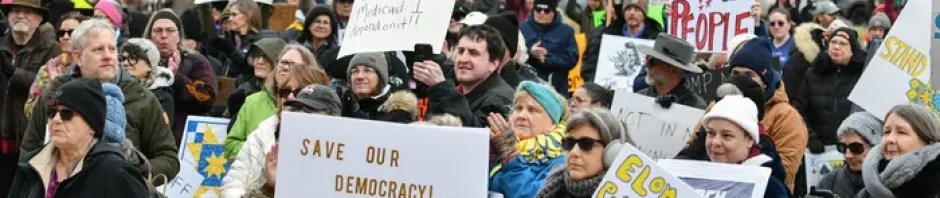
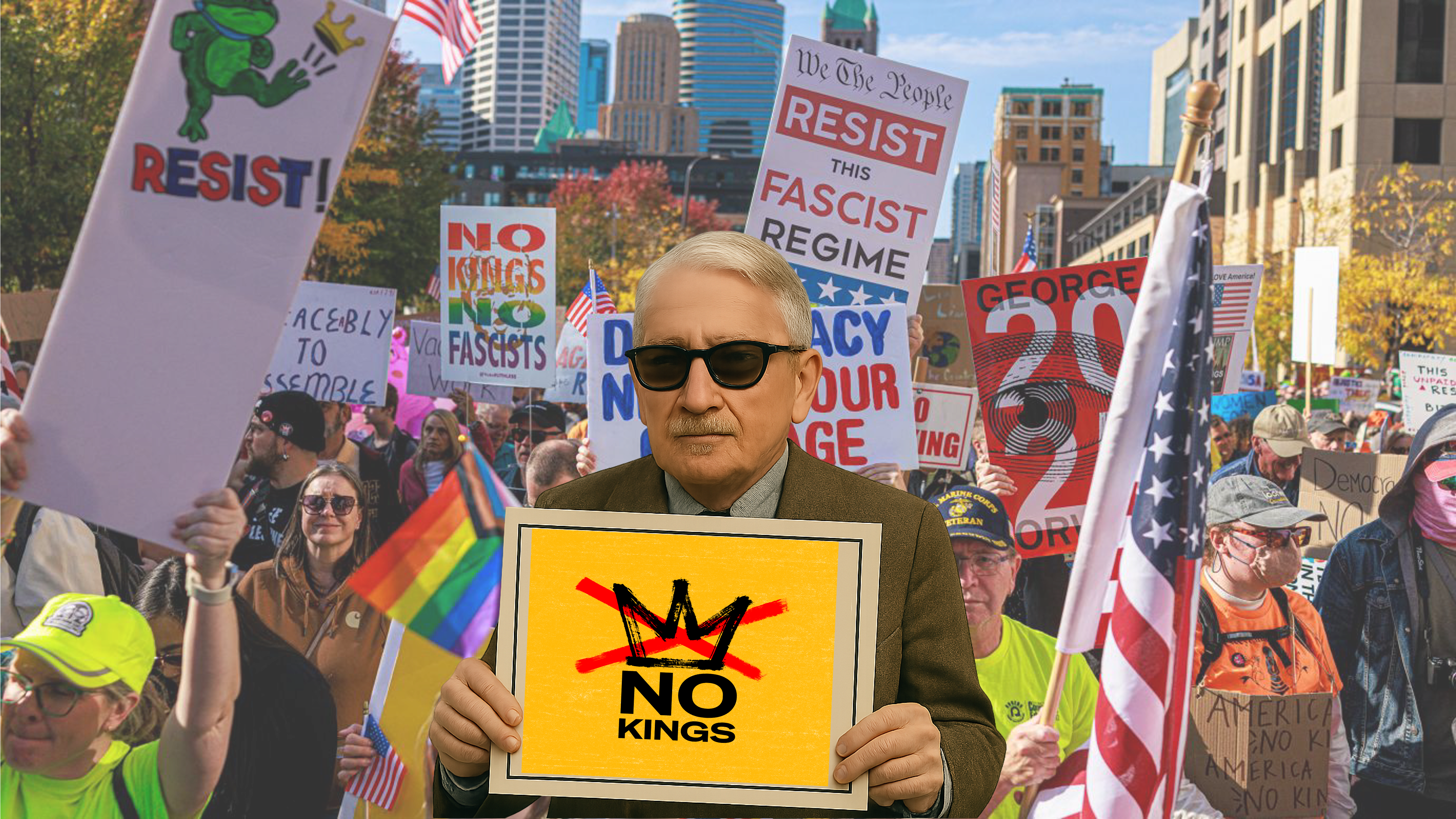
I think this helps us understand some things about Trump and Republicans’ assault on our democracy – and about Saturday’s No Kings protests.
Boiled down to its essence, the Republican push – led by the Trump-Miller-Vought triumvirate, bolstered by Congress, with pathways cleared by the Supreme Court – is to (1) ensure that the (structural) minority has no role in any determination of the purposes of the social organism and thereby (2) transform our democratic organism into an entirely different social form, one in which many individuals “are not organs of the common will . . . are outside of the political society in which they live, and are, in effect, aliens to that which should be their own commonwealth.”
I pointed to “structural minority,” because in truth Trump and the Republicans are not – from the viewpoint of our social organism – the majority. Polling clearly shows that their positions on a long list of policies (a long list of manifestations of the public will) are in the minority, and this has been true for some time. Aside from all of the cultural and sociopolitical dynamics that brought Trump back to the Oval Office, none of this would have been possible without longstanding structures overempowering the Republican power base that, combined with gerrymandering, have effectively and artificially overturned the organic dynamism that Dewey says should be the hallmark of democracy. And what the Republicans want is more of the same and then some.
What makes the No Kings protests important in this respect is that it is the structural minority – i.e., real majority – working to reestablish the organic nature of democracy – a social organism in which democratic processes really are about producing a “common will.” It is a little disappointing that the national turnout was not larger, but a 40% increase over June is nothing to sneeze at. If we grow by 40% every 3-4 months, by spring we will be at 13 million – the 3.5% of the population that theorists say leads to successful resistance to authoritarian regimes. And there are promising signs that things will move more quickly than that.
For the long term, we have to acknowledge that we are a long way from Dewey’s conception. Over much of the past half century, we have been moving both closer to it – with the expansion of rights and inclusion for people of color, women, LGBTQ+ and more – and farther away from it, with the structural matters I just mentioned. As we move forward, it is critical that we develop a vision for how to nurture the social organism and ensuring that everyone knows they are together in the commonwealth.
 Affirming Democracy, Gathering Resistance
Gary, it’s brilliant to bring us back to Dewey’s very pragmatic and clear-sighted ideas about democracy. (I’m proud that Dewey taught philosophy at the University of Michigan for several years at the end of the nineteenth century.) And the phrase you quote from Dewey, “in effect, aliens to that which should be their own commonwealth”, very accurately captures the attitude that Trump and his administration take towards the millions of Americans who object to his goals, values, and personal amorality. This was revoltingly demonstrated with Trump’s AI-generated video of himself dumping on the “No Kings” demonstrations. What kind of person would take such a revolting image to represent how he thinks about the citizens he has sworn to represent and whose rights and liberties he is constitutionally obligated to respect and defend? Have you no shame,Mr President? Have you no shame?